
Two Bets in One — That’s the Catch
An each-way bet isn’t a safety net — it’s a calculated decision that halves your margin for error while doubling your stake. That distinction matters, because most punters who default to each-way on greyhounds treat it as insurance rather than what it actually is: a structured two-part wager with its own breakeven logic.
In greyhound racing, each-way occupies a peculiar middle ground. The fields are small — six dogs in a standard race — which compresses the place market into just two positions. That’s a critical difference from horse racing, where each-way terms might cover three or four places in a large field. With greyhounds, your dog needs to finish first or second. Nothing else counts. The reduced field size means the place portion of your bet is working with tighter margins, and the odds you receive on that place leg are a fraction of the win price.
Despite this, each-way remains one of the most popular bet types at UK greyhound tracks. Tote windows process thousands of each-way slips every evening. Online, the each-way checkbox is ticked almost reflexively by punters who want a return even when their selection doesn’t win. The appeal is obvious: you can back a 5/1 shot, watch it finish second, and still collect. But the maths behind that collection is less generous than the emotional comfort it provides.
Understanding when each-way genuinely improves your position — and when it simply dilutes your profit — is one of the more underrated skills in greyhound betting. It requires looking past the instinct to hedge and instead asking a harder question: does the place return justify the extra outlay?
How Each-Way Works in Greyhound Racing
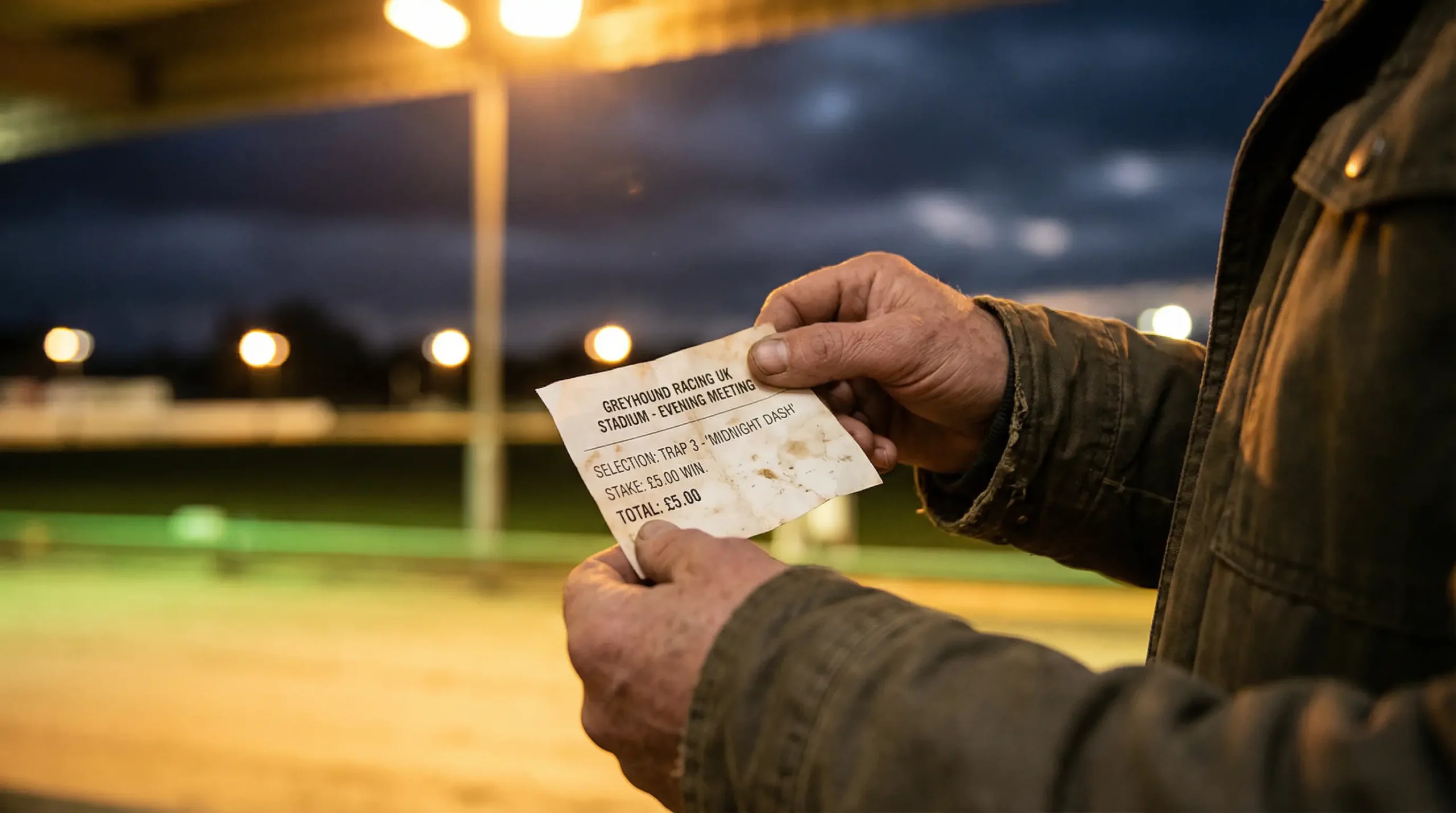
Your £10 each-way becomes two separate bets: £10 to win and £10 to place. Total outlay is £20. If the dog wins, both bets pay out — the win portion at full odds and the place portion at a fraction of those odds. If the dog finishes second (the only other paying position in a standard six-dog greyhound race), you lose the £10 win stake but collect on the £10 place stake at the reduced odds. If the dog finishes third or worse, you lose the full £20.
This two-part structure is fundamental to evaluating each-way in greyhounds. Unlike horse racing, where you might have 12 to 20 runners and three or four places paid, greyhound racing’s compact fields mean the place component covers only two positions. The mathematical probability of finishing in the top two of a six-dog race is roughly 33% if all dogs had equal chances — which they never do, but it establishes the baseline.
The place odds are expressed as a fraction of the win price, and this fraction varies. In greyhound racing, the standard industry terms are one-quarter of the odds for a place. So if your dog is priced at 8/1, the place portion pays 2/1. If it’s 4/1, the place leg returns at evens. At shorter prices, the place return shrinks rapidly — a 2/1 selection pays just 1/2 for a place, meaning your £10 place bet returns £15 (£5 profit plus £10 stake).
Place Terms in 5-Dog and 6-Dog Fields
The number of runners directly affects whether each-way is even available. In a standard six-dog greyhound race, bookmakers typically pay two places. The win portion works as normal, and the place fraction is usually one-quarter of the win odds. If a race is reduced to five runners — through a non-runner, for instance — most bookmakers still offer each-way on two places, but some may adjust the terms or withdraw the each-way option entirely. Always check the specific terms before placing.
When a field drops to four runners, each-way is generally unavailable. The reasoning is straightforward: with only four dogs and two places being paid, half the field would qualify for a place return, making it too generous a proposition for the bookmaker. Some operators offer place-only betting in reduced fields, but these are separate markets with their own pricing — not the same as the each-way structure.
At races with more than six runners, such as certain historical open races or events that permitted seven or eight dogs (note that eight-dog races are no longer held at GBGB tracks), the place terms may expand. Some bookmakers extend to three places in an eight-dog race, though this is track-specific and not universal. The key habit is never assuming the terms — check them for every race, every bookmaker, every time.
Quarter Odds vs Fifth Odds: Bookmaker Differences
While one-quarter of the odds is the standard place fraction for greyhounds across most UK bookmakers, it is not the only option. Some bookmakers, particularly during promotional periods or for specific high-profile races, may offer enhanced each-way terms — one-third of the odds instead of one-quarter, or occasionally even one-half for selected events. These enhanced terms shift the breakeven calculation significantly in the punter’s favour.
Conversely, there are instances where bookmakers apply one-fifth of the odds. This tends to be rarer in greyhound racing compared to horse racing handicaps, but it does appear. The difference between one-quarter and one-fifth on an 8/1 selection is meaningful: at one-quarter, the place pays 2/1; at one-fifth, it pays 8/5. On a £10 place stake, that’s a difference of £4 in profit. Over dozens of bets across a season, that gap compounds.
Experienced punters compare each-way terms across bookmakers before committing. If one operator offers one-quarter and another offers one-third on the same race, the each-way value shifts materially. This comparison is particularly worthwhile for bigger-priced selections, where the fractional difference produces a larger absolute return on the place leg.
When Each-Way Pays and When It Costs
Each-way only offers real value when the place return covers your total outlay — or comes close enough that the win portion doesn’t need to compensate for a persistent loss on the place side. This is where most punters go wrong. They think of each-way as a cheaper version of a win bet with a consolation prize built in. It isn’t. It’s a more expensive proposition that only makes financial sense under specific conditions.
Consider a dog priced at 3/1. An each-way bet at £10 costs £20 total. If the dog wins, you collect £30 profit on the win leg plus £7.50 on the place leg (3/4 of £10 at quarter odds), for a total return of £57.50 including stakes — a net profit of £37.50. If the dog finishes second, you collect £7.50 on the place leg but lose the £10 win stake, netting a loss of £2.50. That second-place finish doesn’t break even. You need a win price of at least 4/1 before the place return at quarter odds (evens) covers your total outlay with a second-place finish. At 4/1, the place pays £10 on a £10 stake — exactly your total stake on the place leg alone. But you’ve also lost £10 on the win leg, so a place at 4/1 still produces a net zero, not a profit.
The breakeven threshold for each-way on greyhounds, assuming standard quarter-odds terms and two places, requires the win price to be above 4/1 before a place-only result generates any net return. Below that price, every place finish is a losing outcome in absolute terms — less of a loss than finishing out of the places entirely, but a loss nonetheless. This doesn’t mean you should never bet each-way on shorter-priced dogs. It means you should only do so when you genuinely believe the dog has a strong chance of winning, and the each-way stake on the place is essentially reducing variance rather than chasing a consolation payout.
Where each-way genuinely shines is on bigger-priced selections in competitive fields. A 10/1 shot finishing second returns 5/2 on the place leg — a £10 place bet returns £35. Subtract the £10 lost win stake and you’re still £15 in profit from a dog that didn’t win. At 8/1, the place returns 2/1, producing £30 for a £10 net profit after the dead win stake. These are the scenarios where each-way operates as a genuine strategy rather than a comfort blanket.
There’s also the question of how often each-way punters are right about the place but wrong about the win. If you consistently identify dogs that finish in the top two but rarely first, each-way at larger prices can accumulate steady returns. But if your selections are finishing third and fourth, each-way is simply doubling your rate of loss. The honest assessment of your own selection accuracy is more important than any abstract analysis of place terms.
One final tactical consideration: the tote. Tote place pools at greyhound tracks operate differently from fixed-odds each-way. The place dividend is calculated from the pool rather than derived from the win price. In small pools, this can produce unexpected dividends — sometimes more generous than bookmaker terms, sometimes less. Checking tote returns against fixed-odds each-way before settling on a method is an extra step that regular trackside punters learn to take automatically.
The Place Money Is the Quiet Profit
Winning punters don’t celebrate wins — they calculate whether the place terms justified the double stake. That sounds cold, but it’s the only way to evaluate each-way as a long-term method rather than a race-by-race emotional hedge.
The arithmetic is unforgiving at short prices. Below 4/1, each-way on greyhounds is essentially a bet-to-win with a more expensive ticket. The place return softens the blow of a near-miss, but it doesn’t produce profit. The sweet spot sits between 5/1 and 12/1, where the place fraction generates a meaningful return even without a win — and where a win produces a significantly larger profit than a straight win-only bet would have at the same stake.
Most punters who use each-way habitually would benefit from a simple exercise: track every each-way bet over a month and calculate the net result separately for the win and place components. The win leg will behave like any win-only record. The place leg will reveal whether you’re genuinely identifying top-two finishers at prices where the place fraction delivers, or whether you’re subsidising losses with money that could have been staked more efficiently elsewhere.
Each-way is a tool. A good one, in the right circumstances. But tools don’t know when to use themselves — that part is on you.
Find more bet type guides at greyhoundracinglegal.
Also explore our every bet type.
