

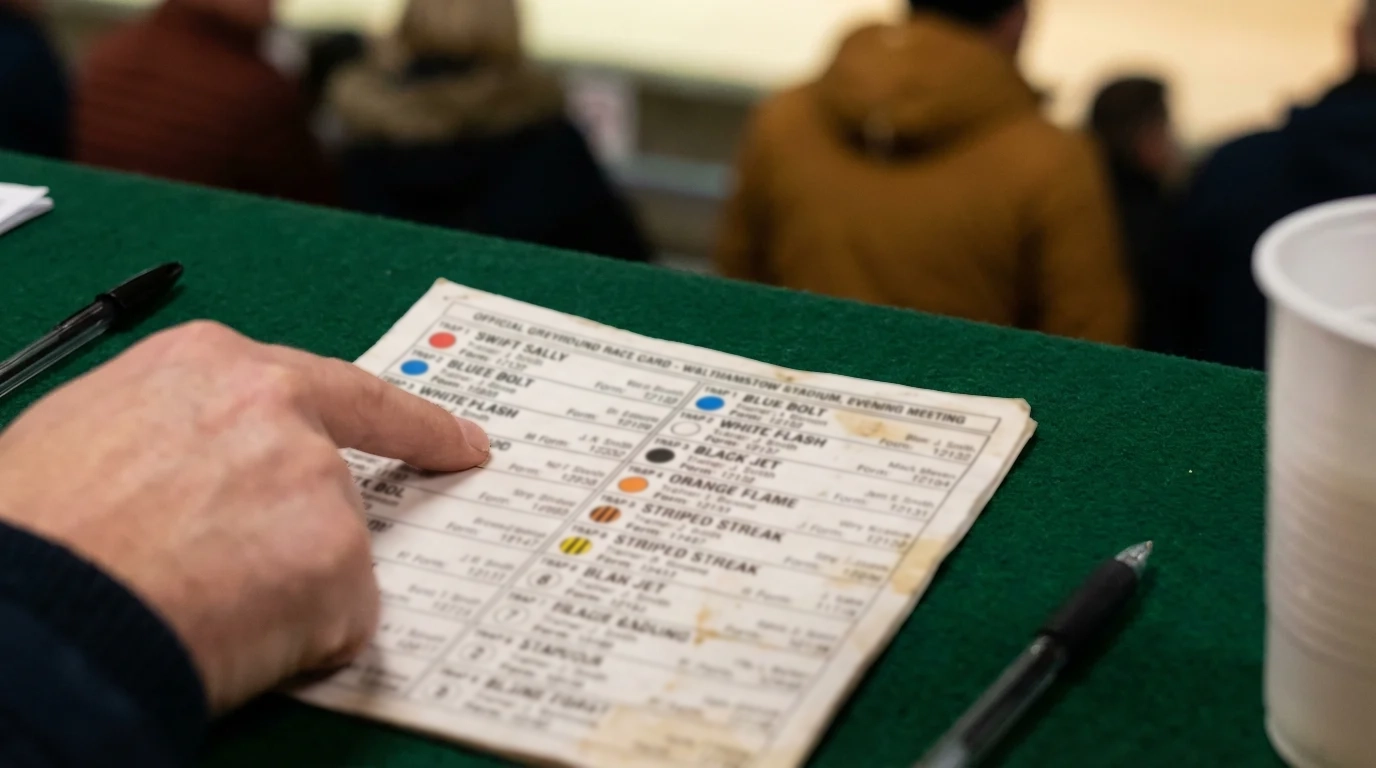
Everything You Need Is on the Card — If You Know Where to Look
A greyhound race card is the single most concentrated source of information available to a punter before a race. Every dog’s recent form, trap assignment, trainer, weight, and calculated times are compressed into a few lines of data. For anyone walking into a track or opening a bookmaker’s greyhound page for the first time, the card can look impenetrable — a wall of numbers, abbreviations, and shorthand that seems designed to exclude newcomers.
It isn’t. The race card is designed to be read quickly by people who bet on multiple races in a single session. Once you understand what each column contains and how to interpret it, the card becomes a rapid assessment tool. You can scan a six-dog field in under a minute and form a preliminary view of which dogs are in form, which have favourable draws, and which are stepping up or down in class. The card doesn’t make your decisions for you, but it gives you the raw material to make them well.
UK greyhound race cards follow a broadly standard format across GBGB-licensed tracks, though the exact layout varies slightly between venues and between printed cards and online versions. The core information is consistent.
Race Card Layout
Header Information
The top of each race entry displays the race number, the scheduled time, the distance in metres, the grade, and the prize money. This header tells you the context before you look at any individual dog. A 480-metre A3 race is a different proposition from a 265-metre A8 race — different speeds, different competitive levels, different betting dynamics. The distance and grade together set your expectations for the type of race you’re assessing.
The prize money indicates the race’s significance. Higher prize money attracts better dogs and, usually, more competitive fields. Category One and open races carry the highest prizes and draw dogs from multiple tracks, while standard graded races at lower levels offer modest purses. For bettors, the prize money is less directly useful than the grade, but it can signal when a race has attracted an unusually strong or weak field for its grade.
Dog Entry Lines
Below the header, each dog is listed on its own line or block, numbered by trap position. The trap number corresponds to the starting position and jacket colour — Trap 1 red, Trap 2 blue, Trap 3 white, Trap 4 black, Trap 5 orange, Trap 6 black and white striped. Each line contains the dog’s name, the trainer’s name, the dog’s form figures, weight, and additional data columns that vary by track and card format.
The ordering is always by trap number, running from Trap 1 at the top to Trap 6 at the bottom. This consistent ordering means you can read the card as a spatial representation of the starting line-up — the top entry is the inside draw, the bottom entry is the widest. Experienced punters read the card in this spatial way, building a mental picture of the trap positions before they examine the form.
Form Figures and Recent Runs
The most prominent data on most race cards is the form string — a sequence of numbers and letters representing the dog’s finishing positions in its most recent races, read from left to right with the oldest run first. A form string of 231154 tells you the dog finished second, third, first, first, fifth, and fourth in its last six runs. The most recent result is the rightmost digit.
Letters within the form string carry specific meanings. An “m” indicates a mid-division finish without a precise placing being recorded (used in some trial or schooling runs). An “F” indicates a fall. A dash or gap may indicate a break between races. The exact notation varies slightly between card providers, and a legend is usually printed at the bottom of the card or available on the track’s website.
The form string is useful but limited. It tells you where the dog finished but not why. A fourth-place finish might represent a strong run hampered by early crowding, or it might represent a dog well beaten in a weak field. The form figures are the starting point for analysis, not the conclusion.
Key Columns Explained
Calculated Time and Sectional Times
The calculated time — sometimes labelled “calc” or “CT” — is an adjusted finishing time that accounts for factors the raw clock doesn’t capture: distance behind the winner, early interference, and crowding. It provides a more accurate picture of the dog’s ability than the raw finishing time alone. When comparing dogs in the same race, the calculated time is a better indicator of relative quality than finishing position, because it normalises for the race circumstances.
Sectional times break the race into segments — typically the run to the first bend and the run from the last bend to the line. These times reveal a dog’s running style in numbers. A fast first-section time indicates early pace; the dog gets out of the traps quickly and leads to the bend. A fast final-section time indicates a strong finish; the dog closes ground in the home straight. Comparing sectional times between dogs in the same race helps you anticipate how the race will unfold — which dogs will lead, which will chase, and which will close.
Weight
The weight column shows the dog’s racing weight, usually in kilograms. Weight fluctuations between races can be significant. A dog that has gained weight since its last run may be less sharp. A dog that has lost weight might be fitter — or might be unwell. Experienced punters track weight changes over a dog’s recent runs and flag any shift of more than half a kilogram as worth investigating.
Weight alone doesn’t predict performance, but sudden or unexplained changes are a warning sign. A dog that raced at 32.5kg in its last three runs and appears at 33.2kg for tonight’s race may be carrying condition that affects its speed. The weight column is one of those data points that means little in isolation but gains significance in the context of a dog’s recent pattern.
Trainer and Kennel
The trainer’s name is listed alongside each dog. In greyhound racing, the trainer is responsible for the dog’s fitness, preparation, and race readiness. Some trainers have strong records at particular tracks or over specific distances, and their name on the card carries information beyond the dog’s own form. A trainer with a 25% strike rate at Romford is placing dogs competitively — their runners merit closer attention than a trainer with a 10% record at the same venue.
Trainer form is tracked by several statistics services and is available on most online race card platforms. It’s an underused filter. When two dogs in a race look equally matched on form, checking which trainer has the better recent record at the track can tilt the assessment.
Comments and Race Notes
Many race cards include a brief comment line for each dog’s most recent run — a shorthand description from the race judge or a form analyst. These comments describe how the dog ran: “led to the third bend,” “crowded on the first turn,” “finished strongly from rear.” The language is compressed but consistent, and regular readers learn the vocabulary quickly.
Comments are valuable for what they explain that numbers cannot. A dog that finished fifth but “bumped and checked at the first bend, lost three lengths” ran a better race than the bare finishing position suggests. A dog that won but “led unchallenged” may have faced weak opposition rather than demonstrating genuine superiority. Reading the comments alongside the form figures and sectional times gives you a three-dimensional picture of each run — position, time, and narrative.
The Card Is the Starting Line
A greyhound race card isn’t a prediction engine. It’s a data sheet. It presents the facts of each dog’s recent history in a format designed for rapid comparison. The skill is in reading those facts critically — not accepting the form figures at face value but interrogating them with the calculated times, the sectional data, the weight changes, and the race comments.
Punters who learn to read the card thoroughly don’t just know more than those who don’t. They see different races. Where a casual bettor sees six dogs and picks the one that has won most recently, a card reader sees six running styles, six trap positions, six recent trajectories of form, and a set of interactions between them that will determine the result. The card provides all of this. The rest is interpretation.
Find more form guides at greyhoundracinglegal.
Also explore our punters form guide.
