

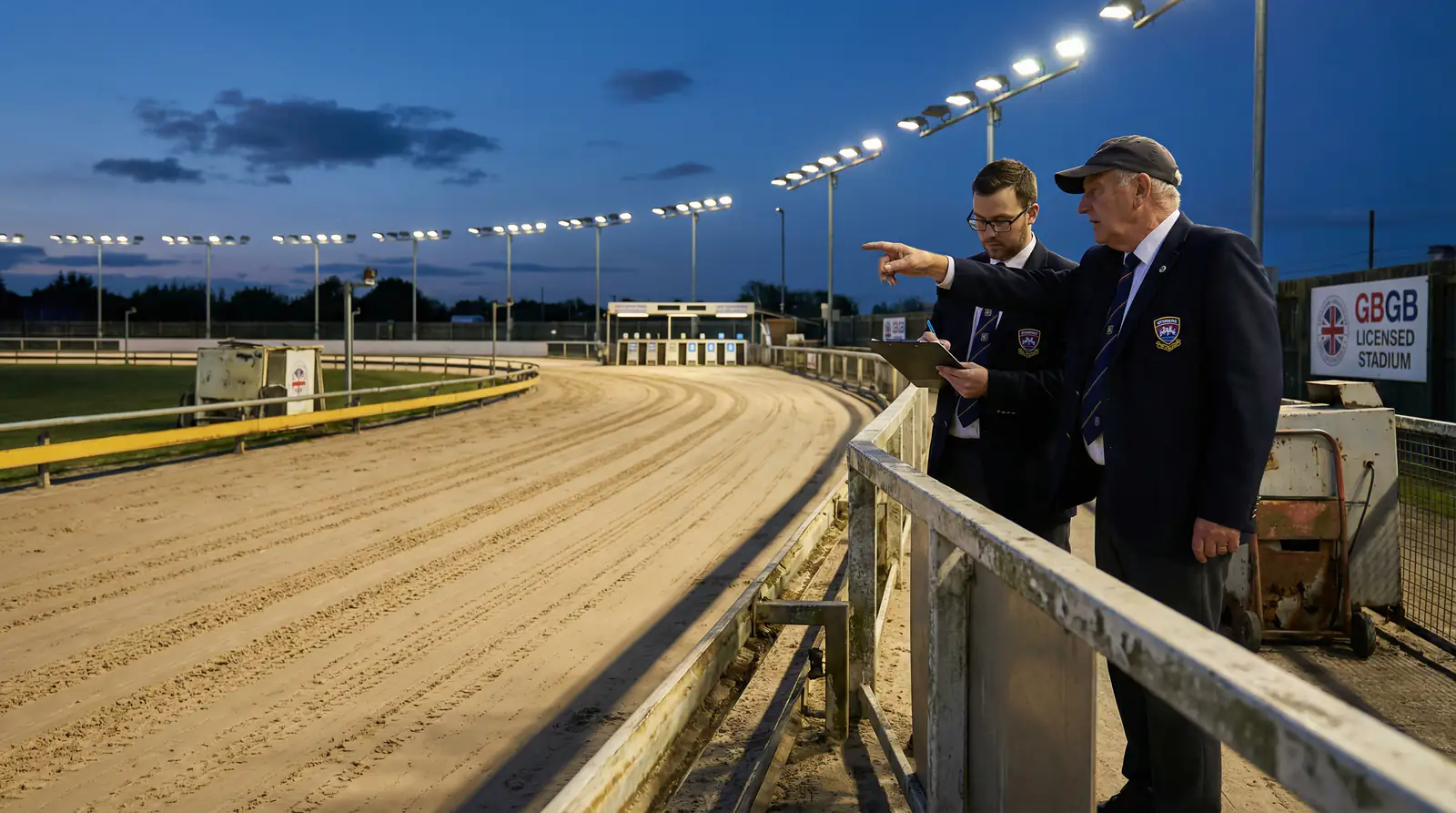
The Rulebook Behind the Racing
The Greyhound Board of Great Britain publishes and enforces the Rules of Racing that govern every aspect of licensed greyhound racing in the UK. These rules cover everything from the dimensions of the starting traps to the procedures for stewards’ inquiries, and they exist for a single purpose: to ensure that the racing is fair, the dogs are protected, and the betting public can have confidence in the integrity of the results.
For punters, most of the rulebook sits in the background. You don’t need to memorise the kennel inspection schedule or the specifications for lure equipment to place a bet. But certain rules directly affect how races are run, how results are determined, and what happens when something goes wrong — and knowing those rules means you won’t be caught off guard when a stewards’ inquiry changes a result or a dog is disqualified after the race.
Key Rules That Affect Bettors
Race Eligibility and Grading
The GBGB rules establish the grading system that determines which dogs are eligible for which races. Dogs are graded by their calculated times at the track where they race, and the racing manager assigns them to appropriate grades. The rules specify how dogs are promoted after strong performances and relegated after weaker ones, creating the dynamic classification system that keeps fields competitive.
For bettors, the grading rules matter because they determine the quality of opposition in any given race. A dog freshly promoted from A5 to A4 is racing under rules that required its recent times to meet a higher standard. A relegated dog is racing against weaker opposition than in its previous run. Understanding that these movements are rule-driven — not arbitrary — helps you assess whether a grade change is likely to help or hinder a dog’s prospects.
Open races operate under different eligibility rules. They are classified by prize money rather than grade, and dogs from different tracks and different grades can enter. The rules governing open race entries are specific about qualification standards, and a dog must meet certain performance criteria to be accepted. This ensures that open races, particularly Category One events, attract genuine contenders rather than padding the field with uncompetitive runners.
Starting Procedures and Trap Rules
The rules prescribe the starting procedure in detail. All dogs must be loaded into the traps before the lure is started. The traps must open simultaneously, and any mechanical fault that produces an uneven start can lead to the race being declared void by the stewards. If a dog refuses to enter the trap or is deemed unfit to race by the veterinary surgeon on duty, it is withdrawn as a non-runner under the procedures set out in the rules.
Trap allocation is governed by the racing manager under GBGB guidelines. Dogs are seeded into traps based on their running style and previous performances. The rules give the racing manager discretion, but that discretion operates within a framework designed to produce fair races. A dog that consistently rails well should be drawn inside; a wide runner should be drawn outside. When the seedings seem inconsistent with a dog’s profile, it may indicate the racing manager is balancing the race to create competitive fields — a consideration that sharp punters factor into their trap analysis.
Stewards’ Inquiries and Objections
After every race, the stewards have the authority to call an inquiry if they believe the running of the race was affected by interference, a breach of the rules, or any other irregularity. The stewards review video footage, consult the veterinary officer if necessary, and can alter the placings, disqualify a dog, or void the race entirely.
For bettors, stewards’ inquiries are significant because they can change the official result after the race has been run. A dog that crosses the line first may be demoted or disqualified if the stewards determine it caused interference that affected the finishing positions. Bets are settled on the official result — which is the result declared by the stewards, not necessarily the order in which the dogs crossed the line. If you backed the dog that finished second and the stewards promote it to first after an inquiry, your bet wins.
The rules also allow trainers to lodge objections within a specified period after the race. Objections are heard by the stewards and can produce the same range of outcomes as an inquiry. The practical impact for punters is the same: the official result may not match the live result, and bets are settled on the stewards’ final declaration.
Doping Controls and Race Integrity
The GBGB operates a comprehensive anti-doping programme. Dogs are tested before and after races for prohibited substances, and the list of banned substances is extensive — covering performance-enhancing drugs, sedatives, painkillers, and any substance that could affect a dog’s racing performance. Samples are collected by the on-duty veterinary officer and analysed at an accredited laboratory.
A positive doping test triggers an automatic inquiry. The dog’s results from the affected race may be voided, the trainer faces disciplinary action, and in serious cases the dog can be excluded from racing for a defined period. For bettors, a voided result due to a doping offence means bets on that race may be recalculated — though in practice, most bookmakers settle bets on the official result at the time of the race and only void bets if the race itself is declared void, not if a subsequent doping test produces a positive.
Integrity measures extend beyond doping. The GBGB monitors betting patterns in partnership with the UK Gambling Commission and sports integrity services. Unusual market movements — a sudden, heavy gamble on a dog whose form doesn’t justify the support — can trigger an investigation. The rules give the GBGB power to require trainers and owners to cooperate with integrity investigations, and failure to cooperate is itself a disciplinary offence.
The trial system also falls under integrity provisions. Dogs undergo official trials before being graded, and their trial performances must be consistent with their subsequent racing performances. A dog that runs significantly faster or slower in a race than in its trial may be referred for investigation, because the discrepancy could indicate that the trial was not run genuinely.
Disciplinary Actions and Penalties
The GBGB’s disciplinary powers are set out in the rules and enforced through a formal hearing process. Penalties range from fines and suspensions to permanent exclusion from licensed greyhound racing. Trainers, owners, and kennel staff can all be subject to disciplinary action, and the hearings are conducted by an independent disciplinary panel.
Common offences that lead to disciplinary action include positive doping tests, failing to comply with kennel standards, running a dog that is unfit to race, and breaches of the rules governing race entries and declarations. The penalties are published in the GBGB’s disciplinary reports, which are publicly available on the GBGB website. These reports are worth consulting for punters who follow specific trainers — a trainer who has been fined or warned may be operating under heightened scrutiny, which can affect the preparation and running of their dogs in subsequent meetings.
Exclusion periods for dogs — typically following a doping offence or a repeated pattern of poor racing behaviour — remove those animals from the racing programme for a defined duration. When a dog returns from an exclusion period, its form is effectively interrupted: there’s a gap in the record, and the dog’s fitness and competitiveness after the layoff are uncertain. Backing a dog returning from a disciplinary exclusion without understanding the reason for the absence is a form of uninformed speculation.
The Rules Protect the Bet
The GBGB Rules of Racing exist primarily to protect the sport’s integrity, the welfare of the dogs, and the interests of the betting public. For punters, the rules are the guarantee that the race you’re betting on is conducted fairly, that the results are subject to scrutiny, and that dishonesty carries consequences. Knowing the rules won’t make you a better tipster, but it will make you a more informed bettor — one who understands what happens behind the result and why the official placings sometimes differ from what you saw on screen.
Find more regulatory guides at greyhoundracinglegal.
Also see our GBGB rules.
