

A Hundred Years at the Dogs
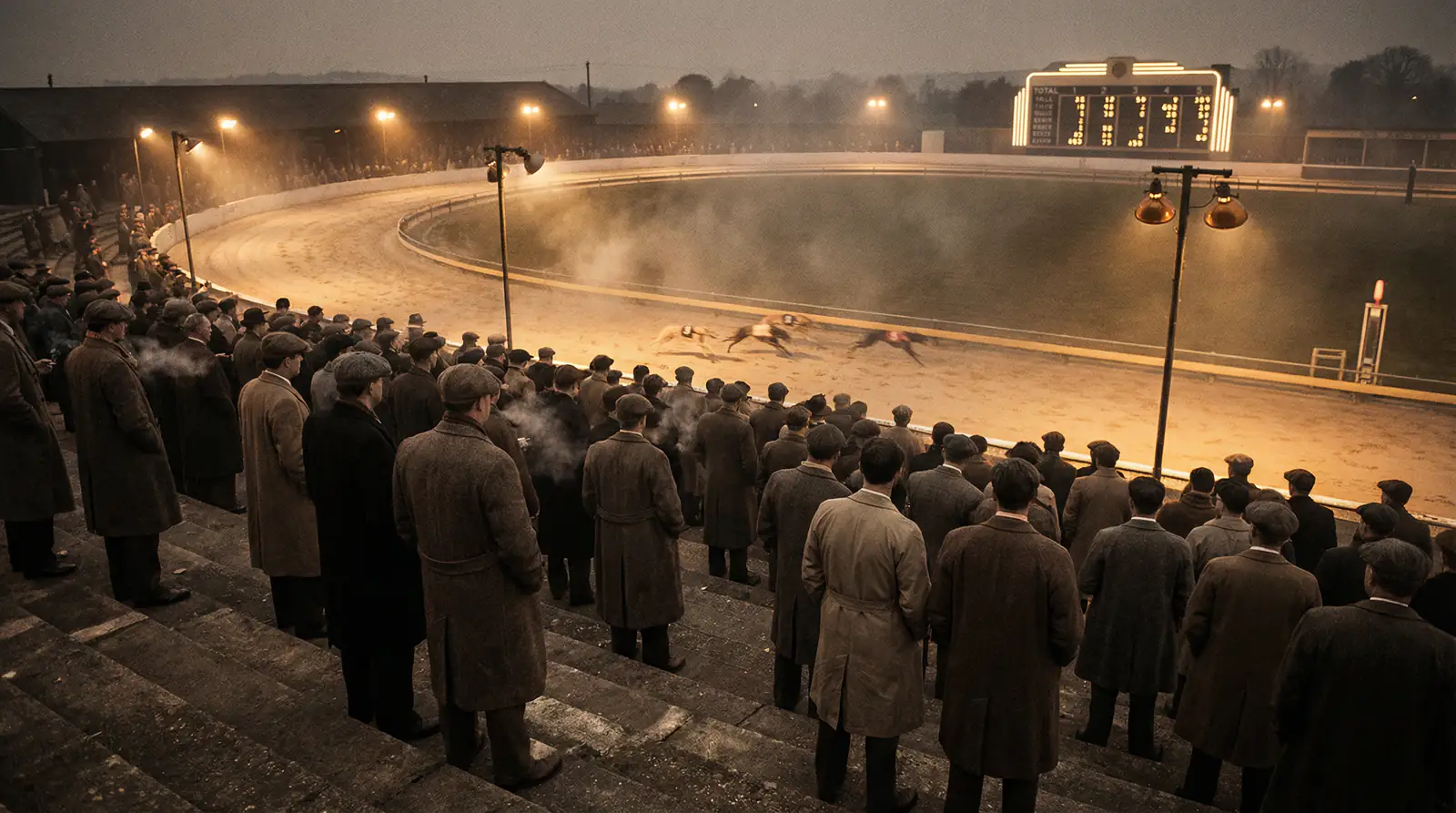
Greyhound racing in Britain turns one hundred in July 2026, and the sport arrives at its centenary in a condition its founders would find bewildering. In 1926, the opening meeting at Belle Vue in Manchester drew a curious crowd of 1,700 — modest, but within weeks the numbers had swelled to 16,000 per meeting. In 2026, the surviving tracks run afternoon fixtures into betting shops where the audience is a camera and a satellite uplink. The century between those two images contains a complete arc — explosive growth, mass popularity, slow decline, and an uncertain present sustained more by the betting market than by spectators in the stands.
The history of greyhound racing is also the history of working-class leisure in Britain, of betting legislation that shaped how and where people could gamble, and of a regulatory apparatus that evolved from nothing to the statutory framework that governs the sport today. Understanding where the sport came from is not an exercise in nostalgia. It explains why greyhound racing is structured the way it is, why the betting market around it functions differently from horse racing, and why the political pressures the sport faces in 2026 have roots that stretch back decades.
The trajectory is not a mystery. Greyhound racing grew because it was cheap, accessible, and perfectly suited to urban populations with limited time and disposable income. It declined because the conditions that created that market changed — television, competing leisure options, betting shop legislation, and the relentless pressure of land values on stadiums that sat on prime real estate. What remains is a sport that has contracted to its commercial core: a daily fixture programme that supplies the betting industry with content, operated on a circuit of tracks that have survived because the economics, just barely, still work.
From Coursing Fields to Oval Tracks
Greyhound racing as a spectator sport did not exist before the 1920s. What existed was coursing — the pursuit of live hares by greyhounds in open fields — a rural pastime with a centuries-long history and a following concentrated among landowners and farmers. Coursing was a private affair, conducted on private land, with betting handled informally among participants. It had no urban presence, no public infrastructure, and no commercial potential beyond the wagers of the participants themselves.
The transformation began with the mechanical hare. The concept, developed in the United States by Owen Patrick Smith, replaced the live quarry with an artificial lure running on a rail around an oval track. The first successful demonstration took place in Emeryville, California, in 1919. The technology solved a problem that had made coursing unsuitable for mass entertainment: it standardised the event. A mechanical hare running on a fixed circuit produced a repeatable, schedulable race that could be staged in an enclosed venue, charged for at the gate, and — critically — bet on through an organised tote system.
The innovation crossed the Atlantic quickly. Charles Munn, an American promoter, and Major Lyne-Dixon, a noted coursing judge, joined forces with Brigadier-General Alfred Critchley and Sir William Gentle to form the Greyhound Racing Association and secured a lease on the Belle Vue stadium in Manchester. The first meeting took place on 24 July 1926, and the response was immediate. Thousands attended. The tote windows were overwhelmed. Within months, promoters across the country were scrambling to open tracks, and by the end of 1927, more than forty greyhound stadiums were operating in Britain.
The speed of the expansion reflected the precision of the market fit. Greyhound racing was cheap to attend — cheaper than horse racing, which required travel to rural courses and carried social expectations that excluded much of the working population. The tracks were built in cities, close to the communities they served, and the meetings were held in the evening, after the working day. A factory worker in Salford or Bermondsey could walk to the dogs after his shift, place a few shillings on the tote, and be home before closing time. No other sport in Britain offered that combination of proximity, affordability, and frequency.
The National Greyhound Racing Club, established in 1928, brought the first layer of governance. It set the rules of racing, registered dogs, and provided the regulatory structure that distinguished licensed tracks from the unregulated independents that sprang up alongside them. The distinction between licensed and unlicensed racing — which persists today as the divide between GBGB tracks and so-called flapper tracks — was drawn in the sport’s first years, and it has shaped the betting landscape ever since.
The Golden Age: 1930s to 1950s
By the mid-1930s, greyhound racing was the second most popular spectator sport in Britain after football. Annual attendance figures reached into the tens of millions. White City in London, the sport’s flagship venue, drew crowds of fifty thousand for major events. The tote turnover across the licensed circuit ran to hundreds of millions of pounds per year — figures that, adjusted for inflation, dwarf anything the modern sport produces.
The appeal was social as much as sporting. Going to the dogs was an evening out. The stadiums offered restaurants, bars, and a social atmosphere that pubs and cinemas could not replicate. The racing itself was secondary for a significant portion of the crowd — the track was a venue, and the races were the entertainment that justified the venue’s existence. The betting was woven into the fabric of the evening, casual and communal, conducted through the tote or with on-course bookmakers who set up their pitches along the rails.
The Second World War disrupted the sport but did not kill it. Several tracks were requisitioned or damaged, but many continued to operate throughout the conflict, and attendance held up remarkably well. Wartime austerity, combined with limited alternative entertainment, actually concentrated the audience. When peace returned, greyhound racing entered its post-war peak. The late 1940s and early 1950s saw the highest sustained attendance in the sport’s history, driven by a population with rising disposable income, a hunger for entertainment after six years of deprivation, and a track network that had expanded to more than seventy licensed stadiums across the country.
The tote monopoly on off-course betting gave greyhound racing a structural advantage that horse racing envied. Punters who wanted to bet on the dogs had to go to the track, which meant every bet generated gate revenue as well as tote commission. The economic model was elegantly self-reinforcing: the betting funded the racing, the racing drew the crowds, and the crowds funded the stadium operations. As long as the crowds kept coming, the model worked. The question that the 1960s would answer was what happened when they stopped.
Decline, Legislation, and the Long Contraction
The Betting and Gaming Act 1960 broke the model. By legalising off-course betting shops for the first time, the Act severed the link between placing a bet and attending the track. A punter who previously had to visit the stadium to bet on the dogs could now walk into a licensed betting shop and back any sport on the card. Attendance at greyhound stadiums dropped immediately and never recovered.
The decline was compounded by television. The BBC and ITV offered entertainment that did not require leaving the house, and the generation that had packed the terraces in the 1940s found itself with a competing claim on its evenings. Car ownership expanded, opening leisure options beyond the walking distance of the local stadium. The social function that greyhound tracks had served — as community venues, as meeting places, as affordable nights out — was gradually absorbed by other institutions, and the stadiums that depended on that function began to empty.
Track closures followed the attendance graphs downward. Stadiums that had been built on urban land in the 1920s and 1930s now sat on sites whose commercial value as housing or retail developments exceeded anything the sport could generate. White City closed in 1984. Wembley closed in 1998. Wimbledon, the last great London venue and home of the English Greyhound Derby, held its final meeting in 2017. Each closure removed a fixture from the racing calendar, a kennel population from the circuit, and a venue from the cultural map of British sport.
The Gambling Act 2005 modernised the regulatory framework but did not reverse the contraction. It brought greyhound betting under the Gambling Commission’s jurisdiction, imposed licensing requirements on operators, and formalised the consumer protection standards that the modern betting market operates under. What it did not do was address the fundamental economic problem: greyhound tracks were worth more dead than alive, and no piece of legislation could change the arithmetic that made redevelopment more profitable than racing.
By the 2010s, the circuit had contracted to around twenty licensed tracks. The BAGS framework — the Bookmakers’ Afternoon Greyhound Service — had become the commercial lifeline, providing tracks with broadcast fees from bookmakers who needed content for their shops and streaming platforms. The sport had pivoted from a spectator business to a content business, and its survival depended not on crowds at the turnstiles but on cameras at the finish line.
The Sport That Refused to Disappear
Greyhound racing in 2026 is a smaller, leaner, and more commercially focused operation than the sport that packed Belle Vue a century ago. The stadiums that remain are the ones that found a viable economic model — usually a combination of BAGS revenue, evening meeting attendance, and ancillary income from restaurants, function rooms, or adjacent leisure businesses. The dogs that race are bred, trained, and graded within a regulated framework that is more rigorous than at any point in the sport’s history. The betting market that sustains the whole operation is accessible to anyone with a smartphone and a bookmaker account, which is a long way from the tote windows on that first July evening.
The centenary arrives with an uncomfortable duality. The sport has survived a century of social change, legislative upheaval, and economic pressure that has killed dozens of its venues and reduced its live audience to a fraction of its peak. It has done so by adapting — moving from a spectator business to a broadcast business, from gate revenue to media rights, from urban entertainment to digital content. That adaptability is genuine and worth acknowledging.
But adaptation is not the same as growth, and survival is not the same as security. The Welsh ban, the Scottish endorsement of prohibition, and the ongoing contraction of the track circuit all point to a sport that is managing decline rather than reversing it. The betting market continues to function. The fixture list continues to fill. The form data continues to flow. For the punter, the practical infrastructure of greyhound betting is intact and operational. The question the next hundred years will answer is whether the sport that supplies it can sustain itself long enough to keep the traps opening.
Learn more about the sport at greyhoundracinglegal.
Also read our major UK greyhound racing events.
