

Beyond Win and Place — Sequencing the Finish
The straight forecast is where greyhound betting starts to reward genuine knowledge of how a race will unfold — not just which dog is fastest, but which two dogs will dominate the finish, and in what order. It’s a step up in complexity from a win bet, but the payouts reflect that difficulty. Forecast dividends in greyhound racing routinely return multiples of 10/1 or 20/1, and tricasts — predicting the first three in exact order — can produce three-figure returns from a modest stake.
These bet types exist because greyhound racing’s compact fields make sequencing the finish a realistic proposition. Six dogs in a race means there are 30 possible straight forecast combinations (6 × 5) and 120 tricast permutations (6 × 5 × 4). That’s manageable. In a 16-runner horse race, the numbers balloon to 240 forecasts and 3,360 tricasts, making exact-order prediction almost entirely speculative. Greyhounds offer a tighter puzzle, and punters who study form, trap draws, and running styles have a genuine information edge.
Forecasts and tricasts also appeal because the returns are pool-based (through the tote) or calculated by computer straight forecast and tricast formulae at fixed-odds bookmakers. Either way, the payout reflects the actual difficulty of the prediction rather than the bookmaker’s margin on a simple win market.
How Forecast Bets Work
Straight Forecast
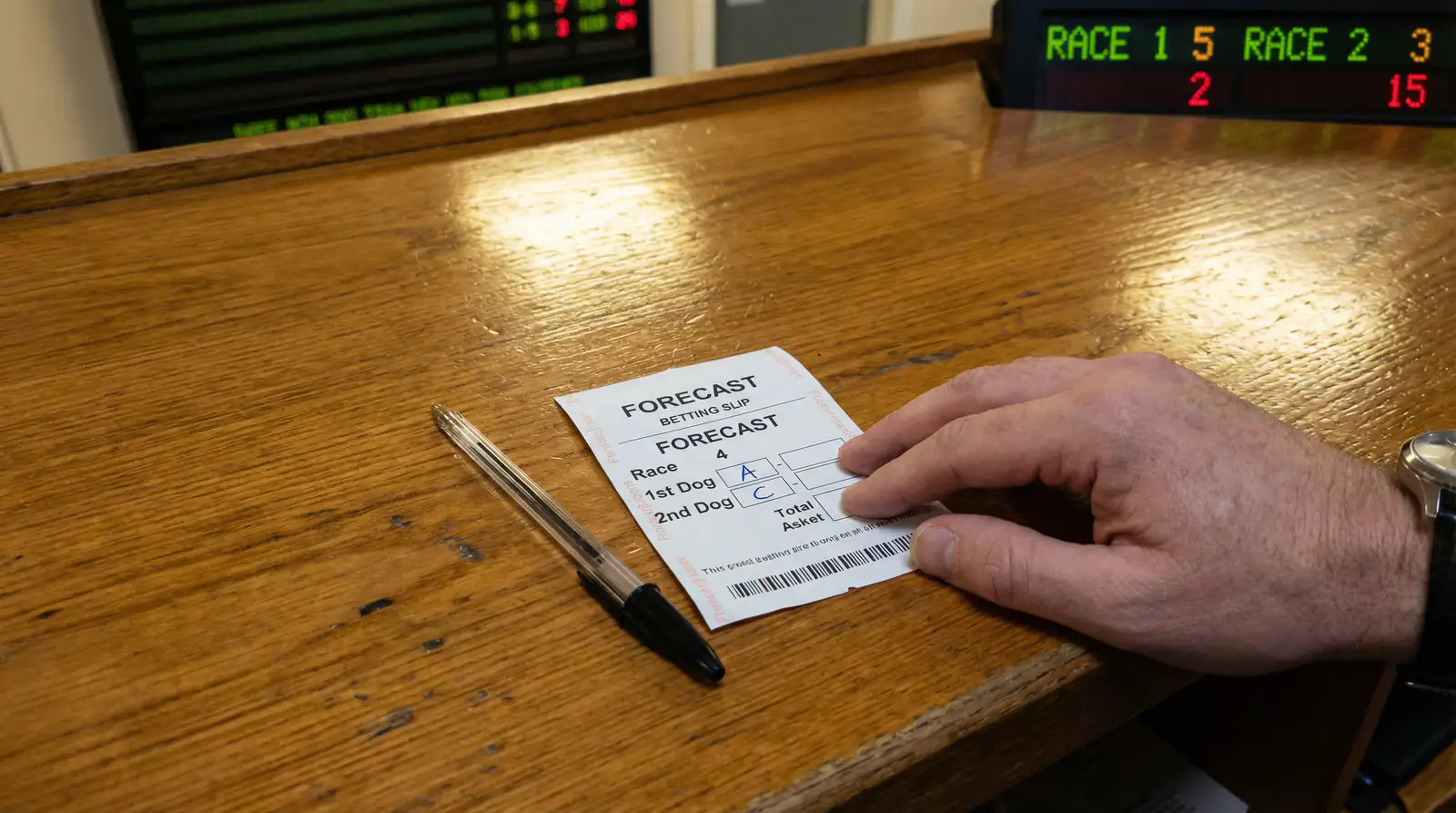
A straight forecast requires you to name the first and second finishers in the correct order. If you back Trap 3 to win and Trap 6 to finish second, that’s your only winning combination. Trap 6 first and Trap 3 second loses. Any other order loses. The precision is the price of entry, and the dividend rewards it.
At fixed-odds bookmakers, straight forecast returns are calculated using the Computer Straight Forecast formula — a mathematical model derived from the starting prices of the two dogs involved. The formula takes the SP of your first selection, the SP of your second selection, and the overall market percentage to generate a dividend. You don’t need to understand the formula to place the bet, but you should know that the CSF dividend is calculated after the race, not before. You cannot take a fixed price on a forecast in the same way you can on a win bet. Some bookmakers display estimated forecast returns pre-race, but these are indicative, not guaranteed.
On the tote, forecasts are pool bets. All money staked on the forecast pool is collected, the operator’s deduction is taken (typically around 20-25%), and the remainder is divided among winning tickets. This means tote forecast dividends can vary wildly from the CSF. In races where a popular combination lands, the tote dividend may be lower than the CSF. When an unlikely pairing comes in, the tote can pay substantially more. Regular forecast punters learn to compare the two and develop a preference based on their selection patterns.
Reverse Forecast
A reverse forecast covers both orders of your selected pair. Back Trap 3 and Trap 6 in a reverse forecast, and you win whether the finishing order is 3-6 or 6-3. The cost is double a straight forecast — a £2 reverse forecast is effectively two £1 straight forecasts. The payout is whichever straight forecast dividend applies to the actual finishing order.
Reverse forecasts are particularly useful when you’re confident about the top two dogs but uncertain which will lead. In greyhound racing, where early pace and trap position can swap expected finishing order, this scenario arises frequently. A strong railer in Trap 1 and an early-pace dog in Trap 6 might dominate a race, but predicting which leads at the line depends on the first bend — and that’s hard to call from a race card alone.
Combination Forecast
A combination forecast extends the logic further. You select three or more dogs and cover every possible first-second pairing between them. With three dogs, that’s six straight forecasts (3 x 2 permutations). With four, it’s 12. A £1 combination forecast on three dogs costs £6; on four dogs, £12. The payout is the single applicable straight forecast dividend.
Combination forecasts are expensive but can be justified in races where you’ve identified three contenders and one of them is at a big price. If the outsider of your three finishes second behind one of the other two, the forecast dividend can be substantial — often enough to cover the cost of the combinations several times over. The discipline required is resisting the temptation to include too many dogs. Every additional selection multiplies your outlay without proportionally increasing your probability of landing the forecast.
How Tricast Bets Work
Straight Tricast
A tricast demands that you name the first three finishers in exact order. In a six-dog race, the 120 possible permutations make this a genuine long-shot proposition even for experienced punters. Tricast dividends reflect the difficulty: returns of 50/1, 100/1, or more are common, and four-figure dividends appear regularly when an outsider fills one of the placing positions.
The Computer Tricast formula, like the CSF, is calculated from starting prices after the race. Tote tricast pools work the same as forecast pools — money in, deduction taken, remainder split among winners. Because tricast pools attract less money than win or forecast pools, the dividends tend to be more volatile. A popular 1-2-3 combination might pay relatively modestly, while an unexpected result can produce an enormous payout from a thin pool.
Combination Tricast
A combination tricast selects three or more dogs to fill the first three places in any order. The minimum combination tricast involves three dogs and costs six times your unit stake (six permutations of three positions). With four dogs, the permutations rise to 24. With five, to 60. The maths escalates fast, which is why most punters limit combination tricasts to three or at most four selections.
The appeal of the combination tricast is that it removes the ordering problem entirely for your selected group. If you believe Traps 1, 4, and 5 will fill the first three positions but have no confident view on the order, a £1 combination tricast costs £6 and covers every possible arrangement. If one of the three dogs finishes fourth instead, the entire bet loses. There’s no partial consolation — it’s the top three or nothing.
Forecast and Tricast Doubles and Trebles
Forecast doubles and tricast trebles link forecast or tricast bets across multiple races. A forecast double requires you to land the correct first and second in two separate races, with the returns from the first carrying onto the second. These bets produce large returns but are exceptionally difficult to land. They represent the more speculative end of greyhound betting, used sparingly by punters who have identified strong races where the top two or three are clear standouts.
The cost structure follows the same multiplication logic: a reverse forecast double on two races involves four bets, and a combination forecast double can run into dozens of individual lines depending on selections per race. Track your total outlay before confirming — it’s easy to build a combination that costs far more than intended.
The Order of Things
Forecasts and tricasts are not bets for every race. They’re bets for races where you have a view — a genuine, form-backed assessment — of how the first two or three positions will shake out. The fields are small enough that this is achievable. The payouts are large enough that getting it right once covers several failed attempts.
The discipline is knowing the difference between a considered forecast and a hopeful one. A considered forecast starts with race visualisation: you’ve looked at the trap draw, the running styles, the early pace of each dog, and you can see a plausible first-bend scenario that leads to a specific ordering. A hopeful forecast starts with the dividend — you want a big return and you’re constructing a selection backwards from the price.
Greyhound racing’s small fields make forecasts and tricasts more viable than in most other sports. But viable is not the same as easy. The punters who profit from these markets consistently are the ones who leave most races alone and wait for the ones where the puzzle pieces click.
Find more bet type guides at greyhoundracinglegal.
Also read our tote betting on greyhound racing.
