

Free Money Has a Price Tag
Every major UK bookmaker offers promotions on greyhound racing — free bets, enhanced odds, accumulator bonuses, money-back specials. The marketing language suggests generosity. The terms and conditions reveal arithmetic. Promotions exist because they are profitable for the bookmaker, not because the bookmaker has decided to subsidise your evening at the dogs. Understanding the mechanics behind each offer type is the difference between extracting genuine value from a promotion and falling for a marketing exercise that costs you more than it returns.
Greyhound-specific promotions are less frequent and less generous than those attached to football or horse racing, because the betting volume on greyhounds is lower and the audience is smaller. But they exist, they recur, and some of them offer real value to the punter who knows how to evaluate them. The key is reading the terms before you read the headline, and calculating the expected value of the offer rather than accepting the bookmaker’s framing of what it is worth.
This guide breaks down the common promotion types available to UK greyhound punters, explains the terms and conditions that determine their true value, and provides a framework for deciding which offers are worth using and which are worth ignoring.
Common Promotion Types in Greyhound Betting
Bookmaker promotions fall into a small number of structural categories, each with a different mechanism for delivering the apparent value and a different set of conditions that determine the actual value. The headline — “Bet £10 Get £10 Free” or “20% Acca Boost” — tells you what the bookmaker wants you to see. The category tells you what the offer actually does.
Free Bet Offers and Sign-Up Bonuses
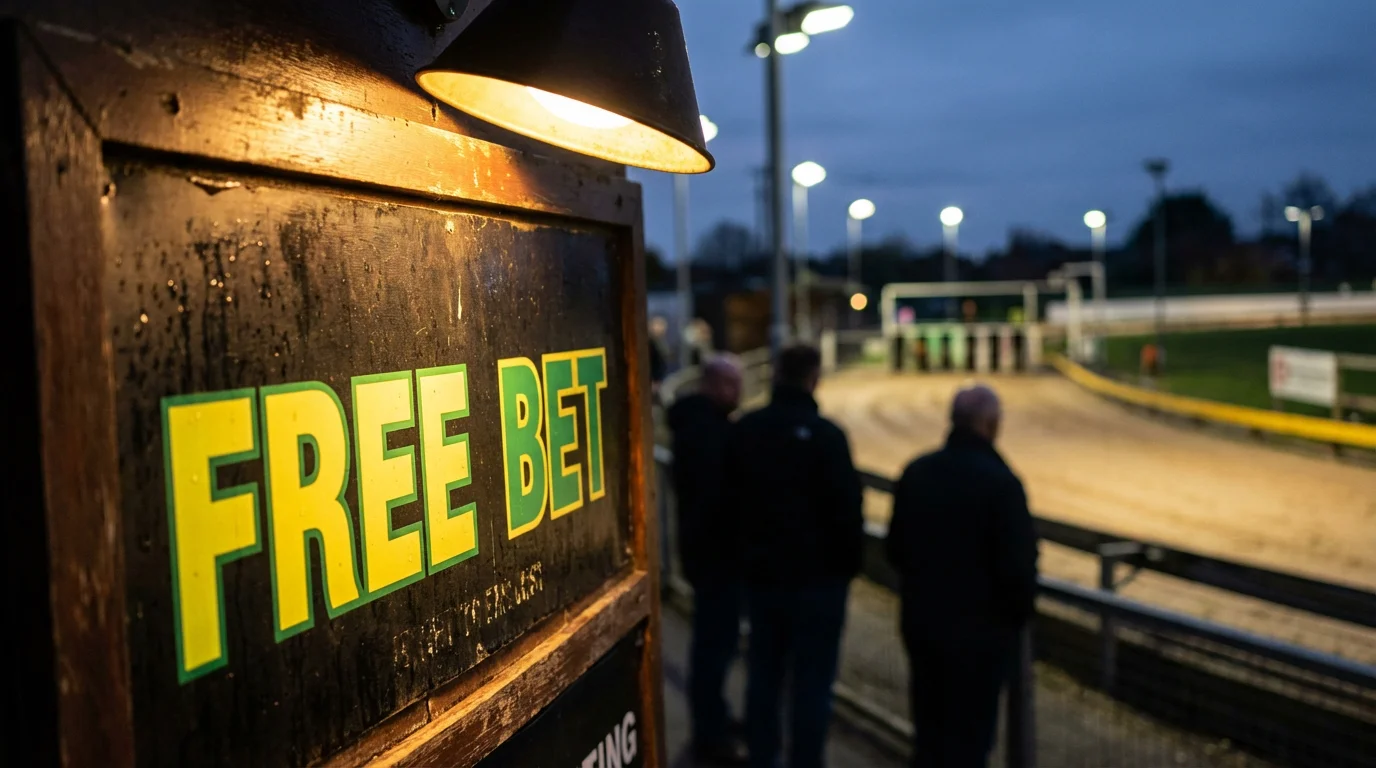
Free bets are the most common promotional tool in UK online betting. The standard structure is a qualifying bet: deposit a minimum amount, place a bet at minimum odds, and receive a free bet token of equal or specified value. The free bet can then be used on a subsequent wager, but with a critical distinction — stake-not-returned. If your free bet wins, you receive the profit but not the original stake. A £10 free bet on a dog at 3/1 returns £30, not £40. That single condition reduces the expected value of the free bet by the probability-weighted stake return, which for most greyhound bets is a significant discount.
Sign-up bonuses follow the same logic on a larger scale. New customer offers — “Bet £20 Get £40 in Free Bets” — are the most valuable promotions available, because the ratio of free bet value to qualifying stake is at its highest for first-time depositors. The bookmaker absorbs a loss on the sign-up offer to acquire a customer whose lifetime betting activity is expected to be profitable. The punter who takes the sign-up offer, extracts the free bet value, and then bets only when genuine value exists is playing the promotion correctly. The punter who takes the sign-up offer and continues betting out of momentum is doing exactly what the bookmaker designed the offer to encourage.
Best Odds Guaranteed and Acca Boosts
Best Odds Guaranteed is not a promotion in the traditional sense — it is a standing offer from bookmakers who agree to pay the higher of the early price or the starting price on selected greyhound races. If you take 4/1 on a dog in the morning and the SP drifts to 5/1, you are paid at 5/1. If the SP comes in to 3/1, you keep your 4/1. The offer eliminates the risk of taking an early price and is one of the few promotions that provides unambiguous value. Not all bookmakers offer BOG on greyhound racing — it is more universally available on horse racing — so checking which operators include greyhounds in their BOG policy is a practical first step.
Accumulator boosts add a percentage to the return on winning multiples. A 10 percent acca boost on a four-fold at combined odds of 20/1 increases the return from £105 to £115.50 on a £5 stake. The boost partially offsets the compounding margin that makes accumulators structurally unfavourable, but it does not eliminate it. The value of an acca boost depends on the percentage, the number of legs, and whether the underlying selections represent genuine analytical opinions or have been assembled to qualify for the promotion. An acca boost on a four-fold you would have placed anyway adds free value. An acca boost that persuades you to add a speculative fourth leg to a treble has cost you expected value, not gained it.
Enhanced Place Terms and Money-Back Specials
Enhanced each-way terms — paying three places instead of two, or offering one-third odds instead of one-quarter — increase the value of each-way bets on selected races. These promotions are most commonly offered on feature meetings or specific televised cards. The value is real and calculable: a dog at 8/1 paying a quarter of the odds for a place returns 2/1 for second. The same dog at enhanced terms paying a third of the odds returns 8/3 — a 33 percent improvement on the place return. Enhanced place terms on a dog you have assessed as likely to place but not certain to win are among the most directly valuable promotions in greyhound betting.
Money-back specials refund the stake — usually as a free bet, not cash — if a specific condition is met. “Money back if your dog finishes second” or “Money back if your accumulator loses by one leg” are common formats. The refund reduces the downside of a losing bet, effectively giving you a partial insurance policy at no additional cost. The value depends on the probability of the trigger condition being met. A money-back offer on second-place finishes in a six-dog field triggers roughly 16 to 20 percent of the time, which provides meaningful insurance on each-way alternatives.
Terms and Conditions: Where the Value Disappears
The terms and conditions attached to betting promotions are not legal boilerplate. They are the mechanism by which the bookmaker controls the cost of the offer and ensures that the promotion generates net revenue rather than net loss. Every condition — minimum odds, wagering requirements, time limits, market restrictions — exists to reduce the actual value of the promotion below its headline figure. Reading them is not optional. It is the analytical step that determines whether the offer is worth taking.
Minimum odds requirements are the most common restriction. A free bet that can only be used at odds of 1/2 or greater excludes the shortest-priced greyhound selections, where the probability of winning is highest and the risk to the bookmaker’s promotional budget is greatest. A free bet that must be used at odds of evens or greater excludes a wider range. The restriction increases the probability that the free bet loses, which reduces the expected cost to the bookmaker and, by symmetry, the expected value to the punter.
Wagering requirements apply primarily to deposit bonuses rather than free bets. A bonus that requires you to wager the deposit plus the bonus amount three times before withdrawing means that a £10 deposit with a £10 bonus requires £60 in total wagers before any winnings become withdrawable. The wagering requirement subjects your money to the bookmaker’s margin repeatedly, and each cycle through the market erodes the expected value. A three-times wagering requirement at a 120 percent overround market reduces the expected return on the bonus to roughly 60 to 70 percent of its face value. Higher requirements reduce it further.
Time limits create urgency. A free bet that expires in seven days pressures the punter into using it regardless of whether a suitable betting opportunity exists. The bookmaker benefits from forced action: a punter who must use a free bet by Friday will bet on Friday’s card even if Friday’s card does not contain a race worth betting on. The result is a free bet placed without conviction, which is the least valuable application of a promotional token. The punter who lets a free bet expire rather than using it on a poor-value bet has made the correct decision, even though it feels like a waste.
Market restrictions limit which bet types qualify. Some free bets can only be used on win singles. Others exclude Tote bets, forecast bets, or specific race types. Each restriction narrows the range of opportunities available and may prevent you from using the free bet on the market where you have identified genuine value. A free bet restricted to win singles when your strongest opinion is a forecast combination is a free bet whose value has been redirected away from your analytical strength.
Evaluating an Offer: Is It Worth Your Time?
The question is not “is this promotion free?” — it always has a cost in time, deposit, or behavioural pressure. The question is whether the expected value of the promotion exceeds the cost of participating in it. A £10 free bet earned by placing a £10 qualifying bet at evens has an expected value of roughly £4 to £5, depending on the odds you use it at and the stake-not-returned condition. If the qualifying bet is one you would have placed anyway, the cost of participation is zero and the expected value is pure gain. If the qualifying bet is one you placed solely to unlock the free bet, the cost is the expected loss on that bet — typically £0.80 to £1.50, depending on the market — and the net expected value is reduced accordingly.
BOG offers require no qualifying bet and impose no conditions beyond placing an early price bet on a qualifying race. The expected value is positive and unconditional. Enhanced place terms on a race you were already planning to bet on each-way are similarly valuable without cost. These are the promotions that deserve priority: offers that add value to bets you would place regardless of the promotion’s existence.
Accumulator boosts and money-back specials sit in the middle. They add value if the underlying bet is one you have genuinely assessed as worthwhile, and they subtract value if they persuade you to modify your betting behaviour — adding a leg, switching from a single to a multiple, or betting on a race you would otherwise skip — to qualify. The discipline is straightforward: decide what you want to bet, then check whether a promotion applies to that bet. Never start with the promotion and work backward to find a bet that fits it.
Sign-up offers are the exception. Their value is high enough that placing a qualifying bet you would not otherwise make is still expected-value positive, because the free bet return exceeds the expected loss on the qualifier. For new customers, sign-up offers are the single most valuable promotional opportunity in greyhound betting, and using them across multiple bookmakers when opening accounts is a rational strategy that the industry has inadvertently designed.
The House Always Offers — But Rarely Gives
Promotions are a feature of the competitive landscape between bookmakers, not an act of charity toward punters. They exist because the cost of acquiring and retaining a customer is lower when wrapped in the language of free bets and bonuses than when expressed as a straightforward discount. The punter who understands the mechanics of each promotion type, reads the terms before engaging, and evaluates the expected value against the cost of participation can extract genuine benefit from the promotional market. The punter who chases every offer without calculation is being marketed to, not rewarded.
The best promotions are the simplest ones. Best Odds Guaranteed costs nothing to use and provides unconditional value. Enhanced place terms on a race you have already analysed improve the return on a bet you were already going to make. Free bets earned through qualifying bets you would have placed anyway deliver expected value for zero additional cost. Everything beyond that — wagering requirements, minimum odds, market restrictions, time pressure — is a mechanism for reducing the value of the offer to a point where the bookmaker’s expected cost is manageable.
Use promotions. Do not be used by them. The difference is whether the bet came first and the promotion followed, or the promotion came first and the bet was manufactured to fit it. The former is a punter exploiting a competitive market. The latter is a customer responding to advertising. The maths is the same. The outcomes are not.
Find more betting guides at greyhoundracinglegal.
Also read our best odds guaranteed for greyhound racing.
