

The Races That Define the Sport
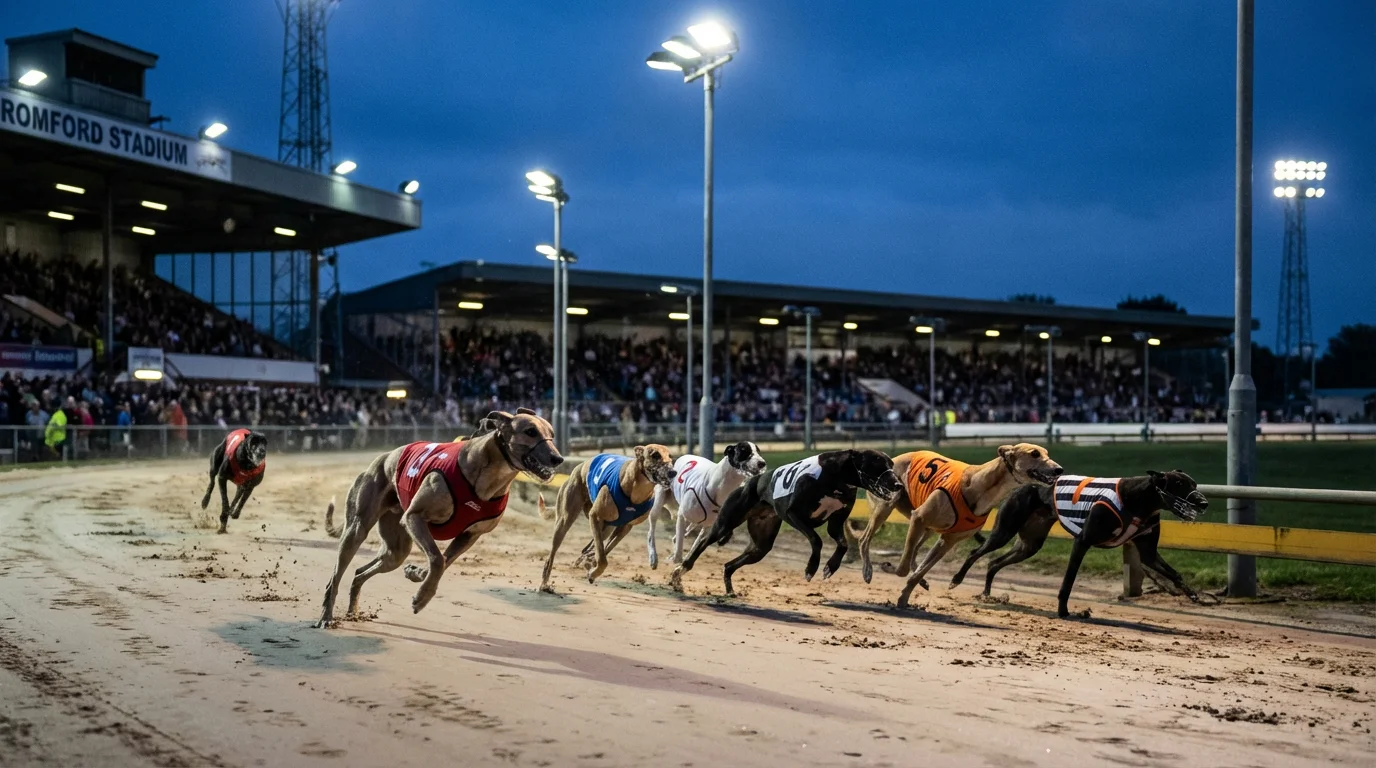
Most greyhound racing in Britain happens on Tuesday afternoons in front of a camera. The graded cards at Monmore, the BAGS fixtures at Romford, the routine ten-race programmes at tracks across the circuit — these are the daily bread of the sport, the content that keeps the betting market fed and the tracks financially alive. But sitting above the daily programme is a calendar of feature events that draws the best dogs, the deepest markets, and the most concentrated attention from punters and bookmakers alike.
The English Greyhound Derby is the centrepiece. Category One races define the competitive summit. The annual calendar structures the sport’s year from spring heats through to autumn finals, and each major event creates betting conditions that differ from the routine graded card — deeper form, more analytical scrutiny, and markets that attract money from punters who would not normally bet on a Wednesday evening’s card.
For the punter, feature events are where form analysis meets its greatest test and offers its greatest reward. The dogs are better. The competition is fiercer. The market is sharper. And the information environment is richer, because major events attract media coverage, expert analysis, and public attention that produce a denser dataset than any mid-week BAGS meeting can generate.
The English Greyhound Derby
The Derby is the race that non-followers have heard of and the one that defines a greyhound’s career. First run in 1927 at White City, a year after the sport arrived in Britain, the English Greyhound Derby is the most prestigious event in UK greyhound racing and one of the oldest continuous competitions in British sport. It has survived track closures, venue relocations, and the broader contraction of the circuit, and it remains the race every trainer, owner, and breeder measures their dogs against.
The modern Derby is run at Towcester over 500 metres, having relocated there after the closure of Wimbledon in 2017. The move from London to Northamptonshire changed the character of the race. Wimbledon’s circuit suited a particular type of dog — fast, tactical, capable of handling a tight track under pressure. Towcester’s larger oval, with wider bends and longer straights, rewards a different profile: dogs with stamina, smooth running style, and the class to sustain speed over a longer, more demanding circuit. The change of venue effectively redefined what it takes to win the Derby.
The competition runs over several weeks, beginning with first-round heats in which a large entry is whittled down through successive rounds to a six-dog final. The structure means that Derby contenders must win or place across multiple rounds, each against different opponents, on the same track, over the same distance. The form that accumulates through the rounds creates a rich dataset for the punter: by the semifinal stage, every surviving dog has run at Towcester multiple times, and the sectional times, trap behaviour, and competitive performance are documented in detail.
Betting markets on the Derby are the deepest of any greyhound event in Britain. Ante-post betting opens weeks before the first heat, with prices available on dozens of entries. The market narrows as the rounds progress and the weaker contenders are eliminated. By the final, the six remaining dogs have been subjected to more analytical scrutiny than any other greyhound field of the year, and the odds reflect a market that has absorbed a wealth of performance data. Finding value in the Derby final is harder than in any graded race precisely because the market has had so much information to process. The value, when it exists, tends to sit in the earlier rounds, where the field is larger, the form is less fully exposed, and the market has more uncertainty to price.
The Derby final is typically held in June and is the most widely covered event on the greyhound racing calendar. Media attention, public interest, and betting turnover all peak for the final, and the winning dog and trainer receive recognition that extends beyond the sport’s usual audience. For the punter, the Derby is both a betting event and a barometer — the quality of the field, the depth of the competition, and the public engagement the race generates all serve as indicators of the sport’s health and relevance.
Category One Races and the Premier Calendar
Below the Derby, a tier of Category One races forms the backbone of the major competition calendar. These events carry the highest prize money, attract the strongest fields, and are staged at the circuit’s principal tracks. The GBGB designates Category One status to races that meet specific criteria of prize fund, entry quality, and competition structure, and the designation signals to punters and the market that a race commands the highest level of competitive integrity and analytical interest.
The Puppy Derby, the Oaks, the St Leger, and the Select Stakes are among the competitions that carry Category One status. Each has its own eligibility criteria — the Oaks is restricted to bitches, the Puppy Derby to younger dogs — and the fields reflect specialised populations within the broader racing community. The betting markets on these events are deeper than standard graded racing but shallower than the Derby itself, creating a middle ground where form analysis is well rewarded but the market has not absorbed every scrap of available data.
Feature open races at individual tracks also carry elevated status within the calendar. The Essex Vase at Romford, major opens at Monmore and Nottingham, and the premier staying events at Towcester all attract fields that exceed the quality of routine graded cards at those venues. These races produce the most competitive betting markets outside the national calendar events and offer the punter a regular schedule of high-quality form analysis opportunities throughout the year.
The competitive depth of Category One fields affects the betting approach. In a graded race, mismatch is possible — a dog racing below its true ability can dominate a field of inferior opponents. In a Category One event, every dog has earned its place through sustained performance, and the margins between runners are narrower. The form analysis must be more precise, the trap draw assessment more granular, and the running style interaction more carefully mapped. The reward for getting it right is a bet in a market where the public money has pushed the obvious contenders to short prices and the less obvious ones — the dog with the awkward draw that the crowd has dismissed, the closer in a field of front-runners — may offer disproportionate value.
The Annual Racing Calendar
Greyhound racing does not have an off-season. The daily programme runs year-round, and the major event calendar is distributed across the twelve months with sufficient density to provide feature-race betting opportunities in every quarter. But the calendar has a rhythm, and knowing that rhythm helps the punter anticipate when the strongest fields, the deepest markets, and the best analytical opportunities will appear.
Spring marks the beginning of the major competition season. Derby trials and early-round heats for the year’s premier events begin to populate the fixture list, and the dogs that emerged from the winter programme as improvers start to test themselves against higher-quality opposition. The form that develops during the spring rounds provides the foundation for the summer’s major finals, and the punter who follows the trials from the first round builds a longitudinal dataset that punters who arrive at the final cold cannot replicate.
Summer is the peak of the calendar. The English Greyhound Derby dominates, and a range of other Category One events — including the Puppy Derby and numerous puppy competitions — run through the summer months. The Oaks and St Leger follow in autumn, extending the major competition season into October. Betting volumes on greyhound racing reach their annual high during the summer finals, and the media coverage — limited though it is compared to horse racing — is at its most visible. For the punter, summer is the season of maximum opportunity and maximum competition: the markets are deeper, but the analytical scrutiny from bookmakers, tipsters, and other punters is also at its most intense.
Autumn transitions into the winter programme, which features a second wave of competitions including stayers’ championships, bitch-only events, and open races at individual tracks that attract strong regional fields. The competitive quality remains high, but the public attention and betting volumes decline from the summer peak. For the analytical punter, autumn and winter can offer better value than summer precisely because the reduced attention produces less efficient markets. A Category One event in November does not draw the same volume of informed money as the Derby final in June, and the odds may not be as tightly compressed.
The calendar’s year-round nature is a commercial necessity — BAGS meetings and evening cards do not pause for a season break — but it also benefits the punter who approaches greyhound betting as a continuous activity rather than a seasonal one. Form libraries build across the year. Trap bias data accumulates. Trainer records develop statistical significance over hundreds of runners. The punter who bets in February has access to a richer dataset than the punter who starts in June, and the calendar’s lack of interruption means that the analytical work done in any month pays dividends in every subsequent month.
The Card Above the Card
Major events are the races that give greyhound racing its public face — the competitions that attract coverage, generate conversation, and remind the wider world that the sport exists beyond the betting shop screen. For the punter, they are also the races that test whether your form-reading discipline, your trap draw analysis, and your understanding of race dynamics hold up when the quality of the field is at its highest and the margin for analytical error is at its smallest.
The daily graded card is where you build your methods. The feature calendar is where you prove them. A punter who can find value in the English Greyhound Derby semifinal — where every dog has been scrutinised by the entire market and the obvious candidates are priced to the decimal — has a process that will work on any Tuesday afternoon at Monmore. The reverse is not always true. The skills that produce profit on weak BAGS cards may not survive contact with a Category One field, because the competition on the track and in the market is sharper than anything the daily programme produces.
Follow the calendar. Track the trials. Build your form from the first round, not the final. The punter who arrives at a major event with six weeks of accumulated data and a clear picture of how each dog performs at the venue holds an advantage that no amount of last-minute research can match. The feature events are announced months in advance. The preparation starts the moment the entry list is published.
Get more race guides at greyhoundracinglegal.
Also read our history of greyhound racing in Britain.
