

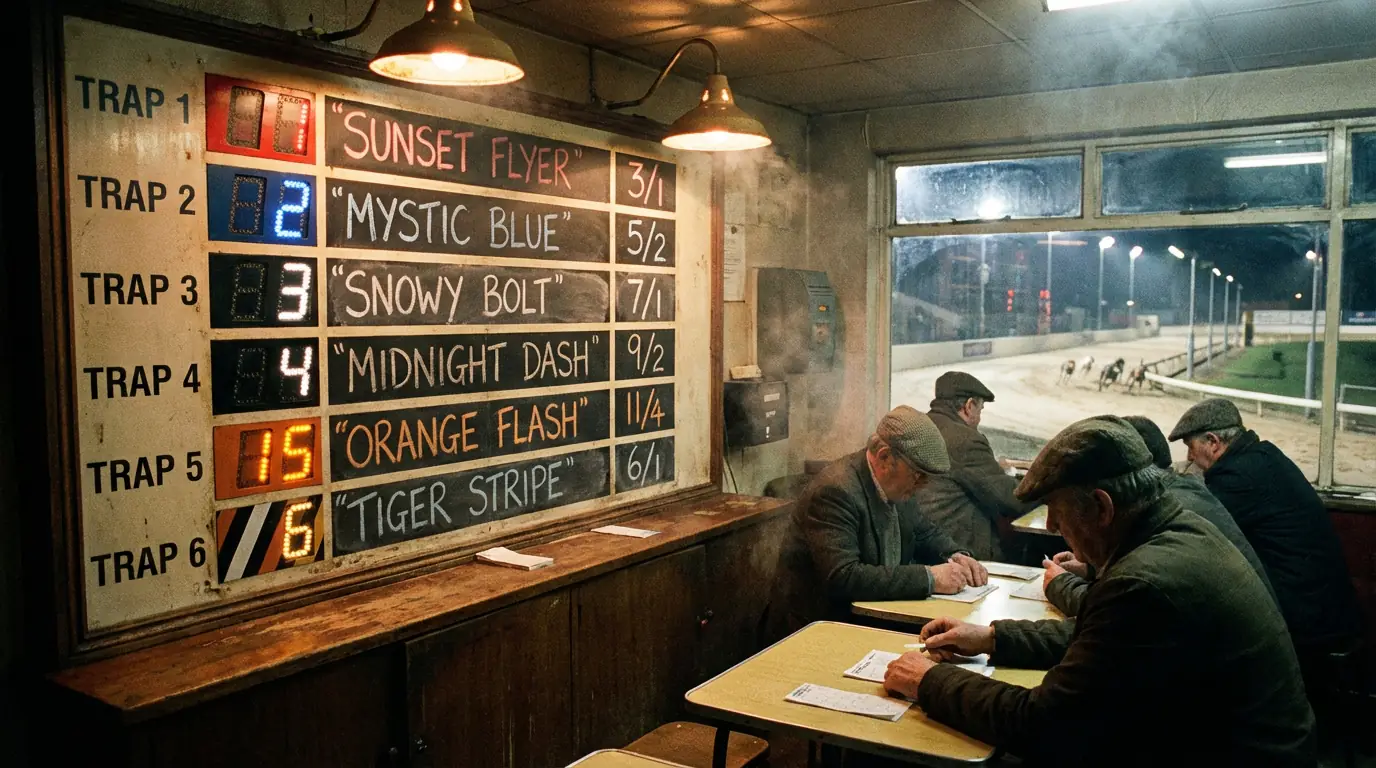
The Price You See Has Already Been Through Three Filters
When you open a bookmaker’s greyhound racing page and see a dog priced at 3/1, that number didn’t appear from nowhere. It is the end product of a process that starts with a trader’s assessment, passes through a mathematical model, and is then adjusted by the weight of money from punters. Understanding how bookmakers construct greyhound odds doesn’t give you a magic formula for beating the market — but it does tell you what the price is actually measuring and where the margin of error sits.
Greyhound markets are compiled faster than almost any other sport. The window from initial pricing to the off can be as little as 15 minutes. That compressed timeframe means the pricing process is more mechanical and less nuanced than horse racing or football, where markets evolve over hours or days. For punters, this speed creates specific opportunities: the initial price is more likely to contain errors that don’t get corrected before the traps open.
Tissue Prices and Market Formation
What a Tissue Price Is
A tissue price is the bookmaker’s initial estimate of each dog’s chance of winning. It is compiled by a trader — sometimes called a compiler or odds-maker — who assesses the form, the trap draw, the grade, and the track conditions to produce a set of probabilities for the field. Those probabilities are then converted into odds and adjusted to include the bookmaker’s margin.
The tissue is not a forecast. It is a starting position — the bookmaker’s best guess before any money enters the market. A good tissue gets the relative pricing roughly right: the strongest dog is shortest, the weakest is longest, and the gaps between them reflect genuine differences in ability. A poor tissue misprices one or more runners, creating value for punters who spot the discrepancy before the market corrects it.
In greyhound racing, tissue prices are heavily influenced by a small number of factors. Calculated times are the primary input — faster dogs get shorter prices. The trap draw carries significant weight, particularly at tracks with known biases. Recent form figures, weight changes, and trainer records are factored in, but with less granularity than in horse racing, where the tissue-making process has access to deeper datasets and longer market windows.
From Tissue to Live Market
Once the tissue prices are set, they go live on the bookmaker’s platform. At this point, punter activity begins to shape the market. If the tissue has priced a dog at 4/1 and punters immediately back it heavily, the price shortens — to 3/1, then 5/2, depending on the volume of money. The other dogs in the field drift to compensate, because the total implied probability of the market must remain within the bookmaker’s target overround.
This adjustment happens in real time and is managed by automated systems at most large bookmakers, with trader oversight for significant moves. The speed of the adjustment depends on the volume of bets and the bookmaker’s risk tolerance. Some operators react to relatively small volumes; others absorb larger bets before adjusting. The variation between bookmakers is itself a source of information: if one operator has shortened a dog to 2/1 while another still shows 3/1, the discrepancy suggests that the first operator has taken more money on that selection — or that its risk thresholds are lower.
The transition from tissue to live market is where most pricing errors are corrected. But in greyhound racing, the correction window is narrow. If the tissue misprices a dog by a point or two and the market doesn’t fully correct before the off, the early price retains the error — and the punter who identified it before the market did has captured genuine value.
Overround and Bookmaker Margins
The overround is the bookmaker’s built-in profit margin. In a fair market for a six-dog race, the implied probabilities of all runners would total exactly 100%. In practice, they total more — typically between 115% and 125% for greyhound racing. That excess is the overround, and it represents the premium the bookmaker charges for offering the market.
An overround of 120% means that for every £100 of theoretical liability, the bookmaker expects to collect £120 in stakes. The 20% surplus covers the operator’s margin and operating costs. For punters, the overround is a tax on every bet: you are paying more for your selection’s implied probability than its true probability warrants. The question is how much more — and that varies significantly between bookmakers and between races.
Greyhound markets tend to carry overrounds in the 118-125% range. This is broadly comparable to horse racing but higher than football match odds, where competition between bookmakers has driven overrounds below 105% on major leagues. The difference reflects the structure of greyhound markets: fewer punters, less liquidity, faster turnover, and a smaller pool of sharp money to punish loose pricing.
Comparing overrounds between bookmakers for the same race is a practical exercise that takes under a minute. Convert each dog’s odds to implied probability, sum them, and the total is the overround. The bookmaker with the lowest overround is offering the best overall value — even if no individual price stands out. Over hundreds of bets, consistently betting with the lowest-overround operator produces a measurable improvement in returns, because you’re paying less margin per bet.
Some bookmakers advertise “best odds” or enhanced markets for greyhound racing, which typically means they’ve reduced the overround for selected races. These promotional markets are worth identifying, because the reduced margin translates directly into better prices for punters across the field — not just on the favourite, but on every runner.
Market Movers and What They Signal
A market mover is a dog whose price changes significantly between the initial tissue and the off. Steamers — dogs whose prices shorten sharply — indicate that money is coming for that selection, either from the general betting public or from punters who are perceived to be well-informed. Drifters — dogs whose prices lengthen — suggest a lack of support, or in some cases active laying by those who believe the dog will lose.
In greyhound racing, market moves are concentrated in the final ten minutes before a race. The compressed timeframe amplifies the signal: a dog that shortens from 5/1 to 3/1 in ten minutes has attracted substantial support relative to the pool size. Whether that support is informed or simply reflects popular bias is the interpretive challenge.
Some punters follow market movers as a primary strategy — backing steamers on the theory that the money knows something the form doesn’t show. The evidence on this approach is mixed. Steamers win more often than their original price implied, which confirms that market moves carry information. But they don’t win often enough at their shortened price to produce a consistent profit, because the shortening has already removed most of the value by the time the move is visible.
Drifters are more interesting from a value perspective. A dog that drifts from 4/1 to 6/1 without any obvious explanation — no non-runner in the race, no negative paddock report — may be offering better value at the longer price than it was at the shorter one. The drift may simply reflect money going elsewhere in the race rather than informed opposition. Punters who had already assessed the dog’s form and concluded it was a fair 4/1 shot can now back it at 6/1 — a significant improvement achieved by doing nothing except waiting.
The Price Is a Product — Treat It Like One
Bookmaker odds are not a neutral assessment of probability. They are a commercial product designed to attract balanced money and generate margin. The tissue reflects the bookmaker’s assessment, but the live price reflects the interaction between that assessment and the money placed by thousands of punters. Understanding this process doesn’t decode the market, but it does strip away the illusion that the price is an authoritative verdict on a dog’s chances. It’s an offer. Whether you accept it depends on whether your own assessment disagrees — and by how much.
Find more odds guides at greyhoundracinglegal.
Also read our how greyhound racing odds work.
