

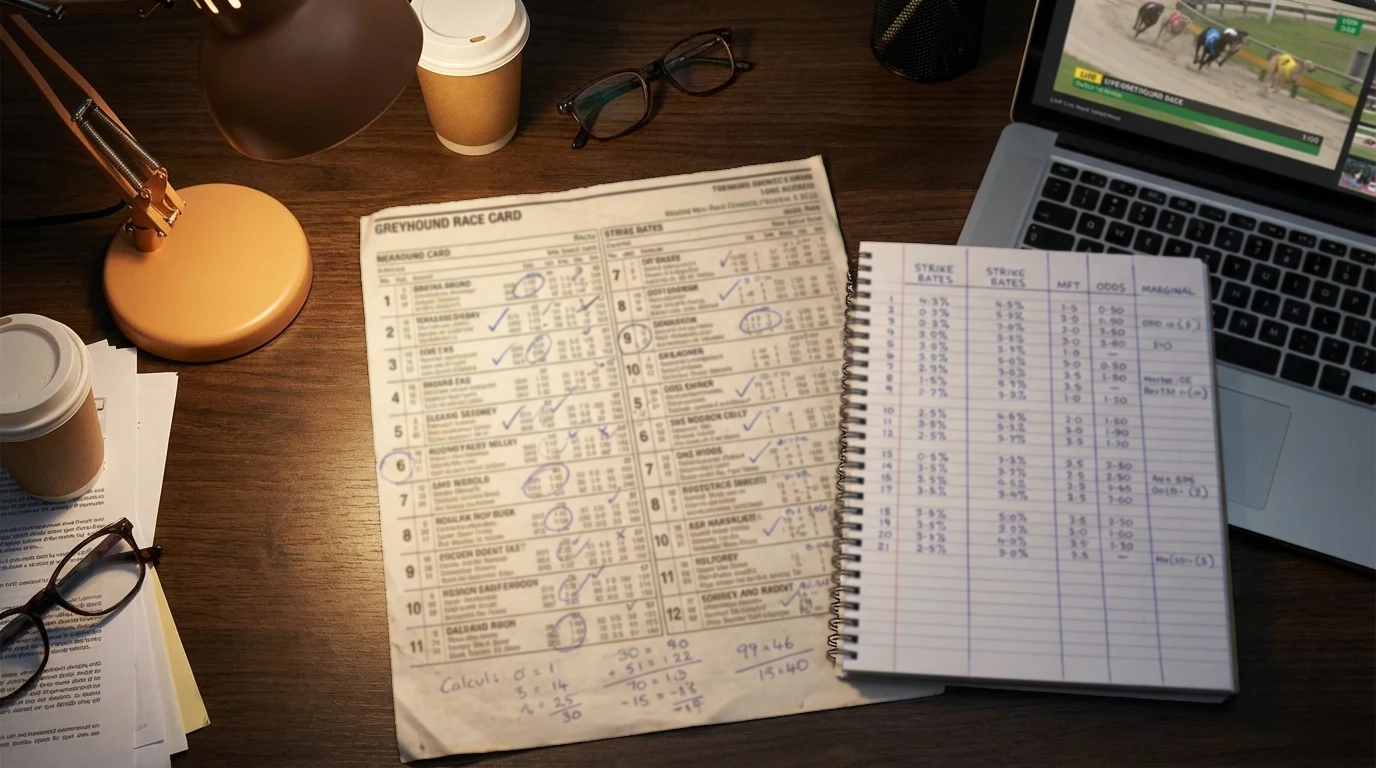
Strategy Is What Happens Before the Bet, Not After
Most punters who bet on greyhound racing don’t have a strategy. They have habits. They back the favourite, or they pick a trap number they like, or they follow a tipster’s selection without understanding the reasoning behind it. These habits produce occasional wins and a long-term loss, which is exactly what you’d expect from an approach that doesn’t involve a systematic edge.
A genuine strategy is different. It identifies a specific, repeatable source of value in the market — a situation where the odds on offer are consistently better than the true probability of the outcome — and exploits it with discipline over a large number of bets. The strategy doesn’t need to be complicated. It needs to be grounded in a real informational or analytical advantage, applied consistently, and measured honestly.
Greyhound racing, with its small fields, fast turnover, and accessible form data, is well suited to strategic betting. The markets are less efficient than football or horse racing. The number of bets available per day — dozens of races across multiple tracks — provides the volume needed to test and refine an approach. What follows are not tips. They are frameworks that produce results when applied with patience.
Value Betting on Greyhounds
Value betting is the foundation of every profitable approach to greyhound racing. The principle is straightforward: back a dog when the odds available are higher than your own assessment of its true probability of winning. If you believe a dog has a 25% chance of winning (fair odds of 3/1) and the bookmaker is offering 4/1, the bet has positive expected value. Over a large enough sample of such bets, the returns will exceed the stakes.
The difficulty is in the assessment. Estimating a dog’s true probability requires integrating multiple data points: recent form, calculated times, trap draw bias at the specific track, the running styles of the other dogs in the field, and any additional factors like grade movements or distance changes. No single input produces the estimate. It emerges from the combination, and the quality of the estimate depends on the punter’s skill in weighting each factor appropriately.
One practical approach is to compile your own ratings before looking at the market. Assess each dog’s chance based on the form, assign a rough probability, and convert it to fair odds. Only then open the bookmaker’s page and compare your prices to theirs. If a dog you’ve rated at 3/1 is available at 5/1, that’s a value bet. If it’s available at 2/1, it isn’t — regardless of how strong the dog looks on form. This sequence — assessment first, market second — prevents the common trap of reverse-engineering your analysis to match a price you find attractive.
Value betting doesn’t mean backing longshots. It means backing anything at a price that exceeds your estimate of its fair odds. That might be a 2/1 favourite that you rate at evens. The margin of value is smaller, but the win frequency is higher. The optimal approach balances the size of the value edge with the win rate, and most successful greyhound bettors find their best results in the 5/2 to 6/1 range, where the edge can be meaningful and the sample size of winners is large enough to verify the method is working.
Specialisation by Track
Greyhound racing rewards specialists more generously than generalists. Every track has its own characteristics — circuit geometry, surface speed, trap bias patterns, typical field quality by grade, and the tendencies of the local trainer population. A punter who knows one track deeply will outperform a punter who spreads attention across ten tracks superficially.
Specialisation works because the market doesn’t fully price track-specific knowledge. A bookmaker’s tissue price is compiled from general inputs: form figures, times, trap draw. It doesn’t always capture the nuance that a specific trap at a specific track underperforms its statistical average when the dog drawn there is a wide runner, or that a particular trainer’s dogs consistently outperform their form at that venue after a seven-day break. These are the kinds of edges that only emerge from sustained observation of the same track over months or years.
The practical approach is to select one or two tracks and immerse yourself. Watch the streams, study the race cards, build a database of notes on individual dogs and how they handle that track. Over time, you’ll develop an intuitive feel for the racing at that venue that no amount of cross-track dabbling can replicate. When a race comes up at your specialist track and you see a mispriced dog, the confidence to back your assessment — even against the market — comes from the depth of your knowledge.
BAGS fixtures make specialisation more accessible than ever. With the same tracks racing on predictable schedules — typically three or four meetings per week at each venue — you can follow a single track without missing significant racing. The dogs at that track become familiar. Their form patterns, trap preferences, and competitive trajectories are part of your working knowledge rather than something you need to look up from scratch.
Lay Betting and Dutching
Lay betting — betting against a dog to win — is available through betting exchanges and inverts the standard punting approach. Instead of identifying the winner, you identify a dog you believe is overpriced by the market and lay it. If the dog loses, you collect the backer’s stake (minus the exchange commission). If it wins, you pay the backer at the agreed odds.
In greyhound racing, lay betting is particularly interesting for short-priced favourites. A dog at 6/4 carries an implied probability of 40%. If your own analysis suggests the dog’s true chance is closer to 30%, laying it offers positive expected value. The liability per bet is manageable at short prices, and the frequency of short-priced losers in greyhound racing is high enough to generate regular returns.
The risk is obvious: when the laid dog wins, the loss is larger than a single losing back bet. Risk management is essential. Staking plans for lay betting should ensure that no single losing lay wipes out several winning ones. A maximum liability of 2-3% of your total bank per lay bet is a common guideline — conservative enough to survive losing runs, aggressive enough to compound gains over time.
Dutching — backing multiple dogs in the same race to guarantee a profit regardless of which one wins — is a different approach. You allocate your total stake across two or three selections proportionally to their odds, so that any of them winning returns a profit. The method works when you’ve identified two or three dogs that are all overpriced relative to your assessment. If the combined implied probability of your selections at market odds is less than 100%, a properly dutched bet across them locks in a positive expected return.
Dutching is mechanically simple but analytically demanding. It requires you to accurately assess three separate probabilities and confirm that the market is overpricing all of them. In greyhound racing’s six-dog fields, this scenario arises more often than you might expect — particularly in competitive races where the market struggles to separate the contenders and spreads its implied probability too evenly, leaving value on multiple runners simultaneously.
The Strategy Is the Discipline
Every strategy described here shares a common requirement: discipline. Value betting only works if you resist the temptation to bet on races where you haven’t found value. Specialisation only works if you resist the temptation to bet on unfamiliar tracks when your chosen venue isn’t racing. Lay betting only works if you resist the temptation to increase your stakes after a winning run.
The greyhound racing calendar provides enough volume that patience is never punished for long. If you pass on a meeting because the value isn’t there, another meeting starts in two hours. The punters who lose in this sport are not the ones who miss opportunities. They’re the ones who manufacture opportunities that don’t exist, placing bets because the next race starts in three minutes rather than because the analysis supports it. Strategy, in the end, is the ability to wait — and to act decisively when the wait is over.
Find more strategy guides at greyhoundracinglegal.
Also explore our punters form guide.
