
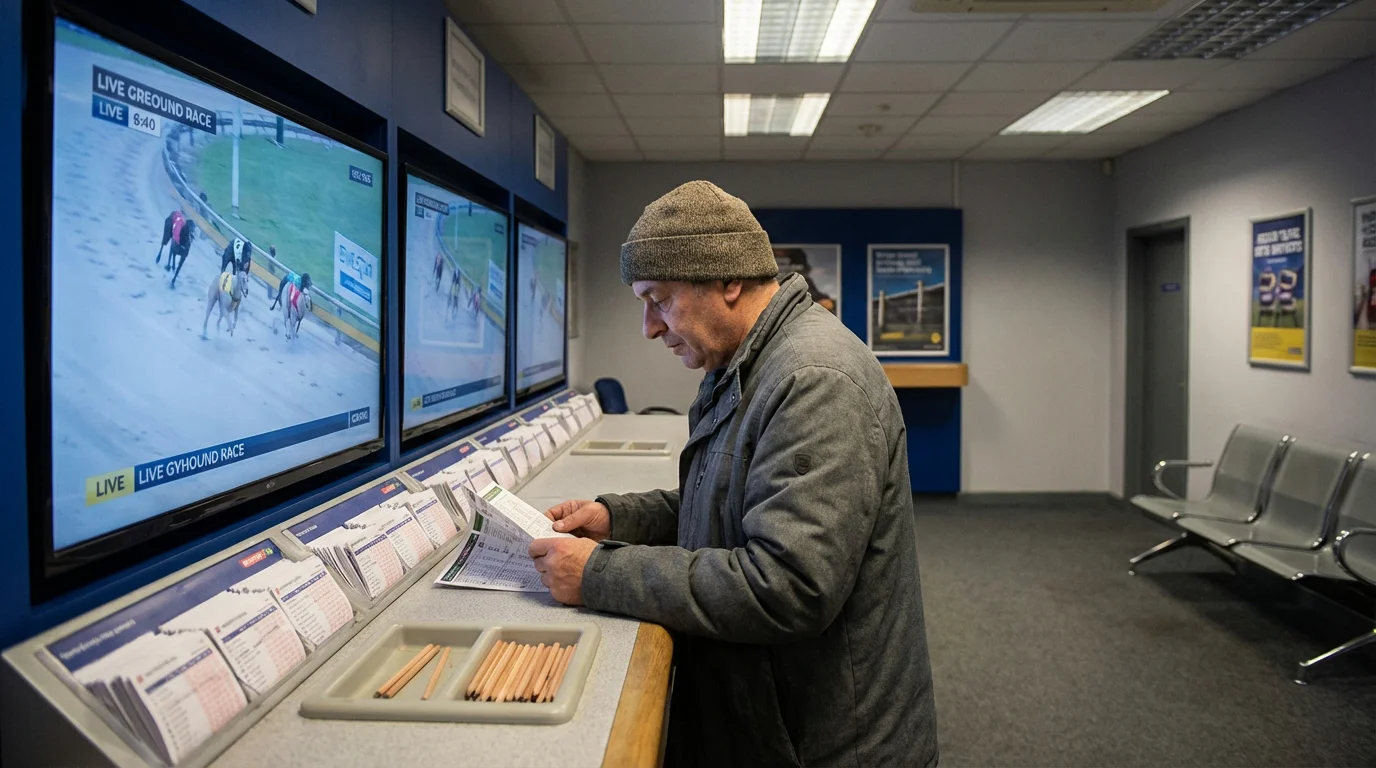
The Engine Behind the Afternoon Card
BAGS is the reason greyhound racing exists as a daily betting product. The Bookmakers’ Afternoon Greyhound Service is not a governing body, not a broadcaster, and not a track operator. It is a commercial arrangement — a framework through which bookmakers pay tracks to stage racing at times that suit the betting shop schedule, with the output broadcast into shops and streamed online through media partners. Without BAGS, the majority of greyhound meetings staged in the UK would not take place, and the sport would contract from a daily fixture programme to a weekend activity.
The concept is straightforward. Bookmakers need content to fill their shops and platforms during the hours when horse racing is not running. Greyhound tracks need revenue beyond what evening attendance and on-course betting can generate. BAGS connects the two: tracks stage daytime and early-afternoon meetings, bookmakers pay a fixture fee for the right to offer betting on those meetings, and the racing is broadcast via SIS and other media providers to every betting shop and online platform in the country. The arrangement turns greyhound racing into a content supply chain, and understanding how that chain works explains why the daily racing card looks the way it does.
For the punter, BAGS meetings are the most readily available greyhound betting opportunities. They run every day of the week, from mid-morning through to early evening, at tracks across the circuit. The form is published, the odds are competitive, and the coverage is live. But not all BAGS meetings are equal, and the informed punter knows the difference between a strong card at a well-supported track and a thin fixture at a venue running at the edges of its competitive depth.
What BAGS Is and How It Works
BAGS operates as a contractual framework between the greyhound racing industry and the major bookmaking chains. The arrangement is managed through the British Greyhound Racing Fund, which negotiates the terms under which bookmakers access greyhound racing content. Tracks that participate in the BAGS programme agree to stage meetings at designated times, produce race cards to the required standard, and provide the broadcast infrastructure — cameras, commentary, timing equipment — that media partners need to deliver the coverage to betting shops and online platforms.
In return, the tracks receive fixture fees. These fees, funded by bookmaker contributions to the BGRF, constitute a significant portion of many tracks’ annual income. For smaller venues, BAGS revenue can represent the difference between operational viability and closure. The fixture fee covers a proportion of the costs associated with staging the meeting — prize money, staff, surface maintenance, veterinary attendance — and provides a predictable income stream that gate receipts alone cannot match, particularly at afternoon meetings where on-course attendance is minimal.
The Commercial Agreement Between Tracks and Bookmakers
The commercial relationship is symbiotic but unequal. Bookmakers generate substantial turnover from greyhound racing — the Gambling Commission’s industry statistics recorded betting shop greyhound turnover of £794 million in the 2023-24 reporting period — while the BGRF’s total annual distribution to the sport sits at around £6.75 million. The racing industry has argued consistently that this ratio is disproportionate and that a statutory levy, analogous to the Horserace Betting Levy Board, would provide a more equitable funding mechanism. No statutory levy has been introduced, and the voluntary contribution remains subject to periodic renegotiation.
The imbalance matters because it constrains what tracks can invest in facilities, prize money, and welfare infrastructure. A track operating on thin BAGS margins has limited capacity to upgrade its surface, improve its kennel block, or increase prize money to attract better-quality dogs. The quality of the racing product — which is what the bookmaker is paying for — is directly linked to the investment the track can make, and the investment is constrained by the revenue the bookmaker is willing to share.
SIS, Media Rights, and the Broadcast Pipeline
Sports Information Services is the primary media partner for BAGS greyhound racing. SIS provides the broadcast infrastructure — camera crews, on-course commentators, and the satellite or fibre connections that deliver the live feed to betting shops and online platforms. The company holds media rights agreements with GBGB-licensed tracks and operates the technical pipeline that turns a race at Monmore on a Wednesday afternoon into a betting event visible on screens in betting shops across the country.
The broadcast quality has improved substantially over the past decade. High-definition camera feeds, multiple angles, and professional commentary have elevated BAGS meetings from grainy shop-floor footage to a product that is visually competitive with other broadcast sports. For the online punter, the same feeds are available through bookmaker apps and streaming platforms, often with additional data overlays showing trap draws, form summaries, and live odds.
Scheduling: How the Fixture List Gets Built
The BAGS fixture list is constructed to fill the gaps in the bookmaker’s daily content schedule. Horse racing dominates the afternoon betting market on Saturdays and during the Flat and jumps seasons, but weekday mornings, early afternoons, and the hours between the last horse race and the first evening greyhound meeting represent dead time for betting shops unless alternative content is available. BAGS meetings are scheduled into those gaps with precision.
A typical weekday BAGS schedule might include a morning meeting starting at 10:30 at one track, an 11:00 meeting at another, a midday card at a third, and an early-afternoon fixture at a fourth. The meetings are staggered so that races from different venues are interleaved, providing a near-continuous stream of results through the day. A punter in a betting shop at lunchtime might see races from three or four different tracks appearing on the screens in rotation, each with its own form, its own odds, and its own market.
The scheduling is not random. Tracks with larger kennel populations and deeper competitive reserves are allocated more fixtures because they can produce stronger cards more frequently. Monmore, Romford, and Crayford appear on the BAGS schedule more often than smaller venues with thinner dog populations. The allocation also reflects logistical constraints: a track cannot run a BAGS afternoon meeting and an evening meeting on the same day without straining its staff, its surface, and its dogs, so the schedule must balance fixture density against operational capacity.
Seasonal variation affects the programme. During the winter, when the National Hunt jumps season and the all-weather Flat programme occupy more of the horse racing calendar, the demand for BAGS greyhound content is slightly lower. During the Flat turf season’s gaps, and particularly during international racing breaks when British horse racing thins out, BAGS fixtures fill a larger share of the betting shop schedule. The fixture list flexes with the broader content market.
The quality of BAGS cards varies not just between tracks but between fixtures at the same track. A Monday morning card at a mid-tier venue may feature lower-grade dogs with shallow form profiles, while a Wednesday afternoon card at the same track might draw from a stronger pool of runners. The informed punter checks the card before assuming that every BAGS meeting offers the same analytical opportunity.
BAGS and the Online Betting Market
The migration of betting from shops to screens has changed the economics of BAGS without changing its function. Online bookmakers stream BAGS meetings through their apps and websites, making every fixture available to every punter with an account, regardless of location. The audience has expanded geographically — a BAGS card from Crayford is as accessible to a punter in Edinburgh as to one in Bexley — and the betting volumes on individual meetings have deepened as the online market aggregates demand from across the country.
For the online punter, BAGS meetings offer the most consistent source of daily greyhound betting content. The meetings are scheduled, the form is published in advance, and the live streaming is available through most major bookmakers as part of a standard account. The data environment is richer than in previous decades: online form services provide sectional times, trap statistics, and historical results databases that were previously available only to on-course professionals or dedicated form students.
The shift to online has also introduced competitive pressure on odds. In a betting shop, the punter takes the price on the screen or walks to the tote window. Online, the same punter can compare odds across multiple bookmakers in seconds, take the best available price, and benefit from promotions — best odds guaranteed, enhanced place terms, accumulator bonuses — that intensify the competition for their business. BAGS meetings now operate in a market where odds comparison is instantaneous and the punter’s ability to shop for value is greater than ever.
Content Is King — Until the Tracks Run Out
BAGS transformed greyhound racing from an attendance-dependent sport into a content-driven business, and that transformation is the reason the sport still operates at its current scale. The bookmakers need the content. The tracks need the fees. The punters need the fixtures. The arrangement holds because each party’s commercial interest aligns with the others’, and it has held for long enough to become the structural foundation of modern greyhound racing in Britain.
The vulnerability is obvious. The content supply depends on tracks, and tracks are closing. Every stadium that disappears from the GBGB register removes fixtures from the BAGS programme, reduces the variety of racing available to the punter, and concentrates the fixture load onto the surviving venues. The remaining tracks can absorb some of that load by running more meetings, but there are physical limits — surface wear, dog welfare, staff capacity — that prevent indefinite expansion.
For now, the system works. The BAGS programme fills the betting shop schedule. The online market deepens the audience. The fixture fees keep the tracks operational. The punter who understands what BAGS is and how it functions sees the afternoon card not as a random assortment of races but as a structured programme, built to a commercial timetable, varying in quality by track and by day, and offering analytical opportunities that reward the same form-based discipline as any other part of the greyhound racing calendar.