
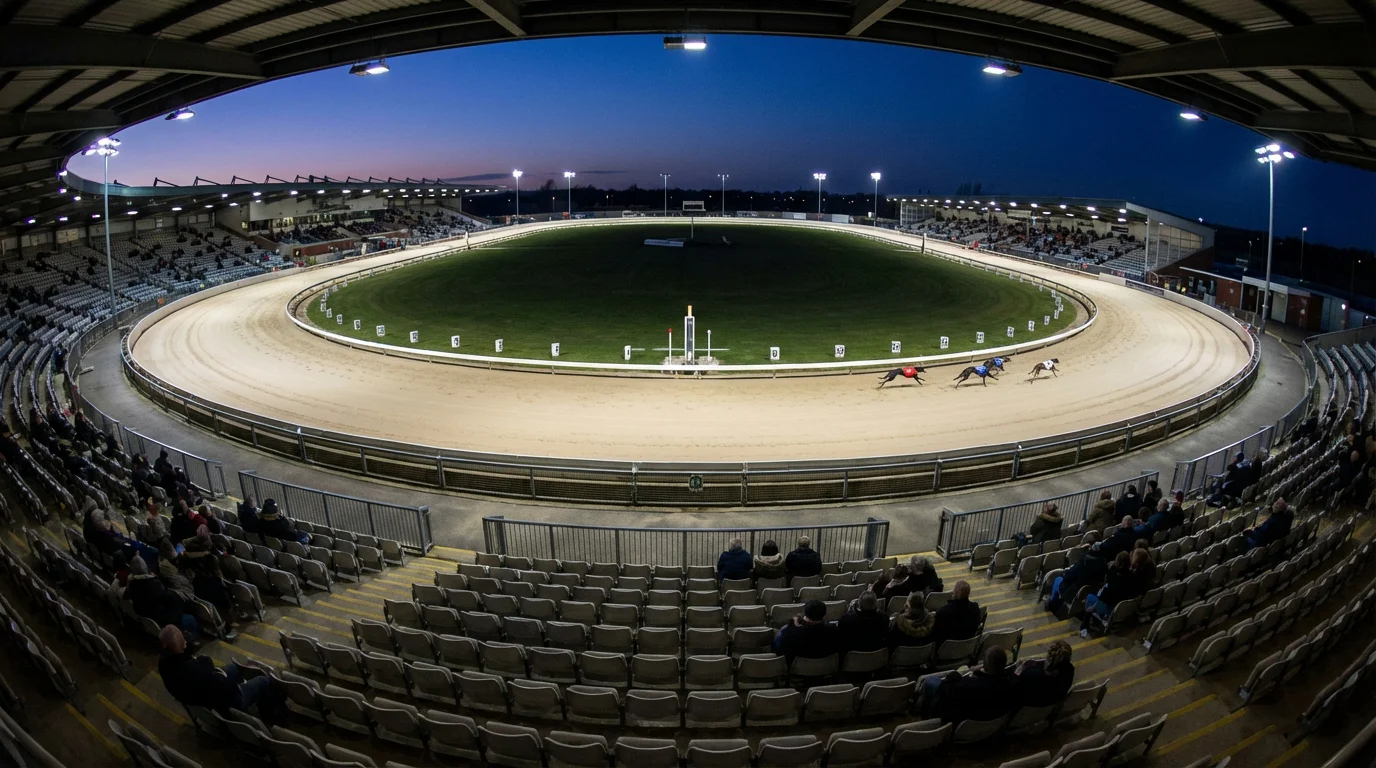
Distance Shapes Everything
Greyhound racing in the UK is run over a range of distances that determines not just how long a race lasts but how it unfolds — which dogs lead, which close, and where the decisive moments occur. A sprint over 210 metres bears almost no resemblance to a marathon over 840 metres, and treating them the same on the betting slip is one of the fastest ways to lose money at the dogs.
Every GBGB-licensed track offers a set of standard distances dictated by its circuit layout. The distances are measured in metres and correspond to the track’s configuration of bends and straights. A four-bend race at one track might cover 400 metres; the same number of bends at a larger track could cover 480 metres. Punters who specialise in specific tracks learn these distance profiles instinctively. Those who bet casually across multiple venues often overlook how a 40-metre difference in race distance can change the complexion of a field.
Distance Categories in UK Greyhound Racing
Sprint Races
Sprint races in UK greyhound racing typically cover distances between 210 and 285 metres, involving two bends. These are the shortest races on the card and are decided almost entirely by trap speed — the ability to break cleanly from the starting box and reach the first bend ahead of the field. Early-pace dogs dominate sprints because there simply isn’t enough track for a slower starter to make up ground. If a dog doesn’t lead by the first bend in a two-bend sprint, it almost certainly won’t win.
For bettors, sprints are attractive because they’re predictable — the dog that leads off the first bend wins more often than in any other race type. But that predictability is priced in. Favourites in sprint races tend to be shorter than in middle-distance events, because the market recognises the pace advantage. The value in sprints, when it exists, comes from identifying a dog whose trap speed is underestimated by the market — often a dog that has been racing over longer distances and is dropping back to a sprint for the first time.
Middle-Distance Races
The standard greyhound race in the UK is a middle-distance event, typically run over four bends at distances between 400 and 500 metres depending on the track. This is where most graded racing takes place and where the form book is most useful. Four-bend races allow for a wider range of running styles to compete: early-pace dogs, stalkers that sit behind the leader and pick off the pace in the home straight, and closers that rely on stamina through the final bend.
Middle-distance racing is the bread and butter of UK greyhound betting. The majority of BAGS fixtures, evening meetings, and graded races are run over standard distances. The form available for these races is the deepest, the markets are the most liquid, and the dogs have typically been assessed over the distance multiple times. For punters, this category offers the best combination of available data and competitive racing — which makes it the most rewarding distance range for serious form analysis.
Stayers and Marathon Races
Staying races cover six bends and distances of approximately 600 to 700 metres, while marathon races extend beyond that to 840 metres or more — involving eight bends in some track configurations. These are the endurance tests of greyhound racing and they produce a distinctly different racing dynamic. Early pace still matters, but stamina becomes the defining factor. Dogs that lead through the first four bends can tire on the final two, and closers that would never catch the leaders in a four-bend race can overhaul them in the home straight of a six-bend event.
Staying races are less common on the daily card than sprints and middle-distance events, which means the form sample is smaller. Many dogs are tried over staying distances only once or twice in their careers, and their aptitude for the trip isn’t always clear from their four-bend form. This information gap creates betting opportunities. A dog with strong sectional times late in its four-bend races might handle the step up to six bends comfortably — but the market, working from limited data, may not price that possibility correctly.
Hurdle Races
Hurdle racing is greyhound racing’s niche discipline. The dogs jump a series of low hurdles placed along the backstraight, adding an obstacle element to what is otherwise a flat sprint or middle-distance race. Hurdle racing is offered at a limited number of UK tracks, and the fixtures are infrequent compared to flat racing. The GBGB’s hurdle specifications govern the design and placement of obstacles.
The hurdles themselves are low enough that most greyhounds can clear them without breaking stride, but the jumping technique matters. Dogs that jump efficiently — maintaining their pace through the hurdle section — have a measurable advantage over those that hesitate or lose momentum at each obstacle. This skill isn’t always apparent from flat form, which means hurdle specialists exist as a distinct category: dogs that may be average on the flat but excel when hurdles are introduced.
From a betting perspective, hurdle races carry higher variance than flat racing. The obstacles introduce an element of unpredictability that doesn’t exist in standard events. Falls are rare but do occur, and even a minor stumble can cost a dog several lengths. Form analysis for hurdle races should weight previous hurdle experience heavily — a dog’s flat form is relevant but secondary to its demonstrated ability over obstacles. If a dog hasn’t hurdled before, backing it in a hurdle race is closer to speculation than analysis.
Distance and Betting Strategy
The distance of a race should be the first thing you look at when assessing a card — before the form, before the trap draw, before the odds. Distance determines which attributes matter most: trap speed for sprints, balanced pace for middle-distance, stamina for stayers. A dog that is brilliantly fast over 285 metres might struggle over 480 because it lacks the engine to sustain its speed through four bends. Conversely, a strong stayer drawn in a sprint will be outpaced before the first bend.
Track-and-distance form is the single most reliable predictor of greyhound racing outcomes. A dog that has won twice over 480 metres at Romford is a more reliable prospect at 480 metres at Romford than a dog with superior form at a different distance or a different track. The surface, the geometry of the bends, and the length of the home straight all interact with the dog’s running style in ways that are distance-specific and track-specific. Ignoring this specificity is ignoring the strongest signal in the data.
Distance changes within a dog’s recent race history are worth flagging. If a dog has been running over 480 metres and is entered over 640 for the first time, the market will often overreact to the uncertainty — either dismissing the dog entirely or treating it as a novelty bet. Either way, distance changes are data events that shift probabilities, and the punter’s job is to assess those shifts more accurately than the market does.
The Clock Reads Differently Over Every Trip
Distance is the most structural variable in greyhound racing. It doesn’t fluctuate like form, it isn’t subject to interpretation like running style, and it doesn’t change between the morning race card and the evening off. It is fixed, published, and identical for every dog in the field. What differs is how each dog handles it — and that difference, mapped against the distance profile of the track and the composition of the field, is where informed punters find their edge.
Learn the distances at the tracks you bet on most. Know which dogs are sprinters, which are stayers, and which are middle-distance specialists. When a dog steps up or drops back in distance, treat it as a material change and reassess accordingly. The price may not adjust. That’s your opening.