
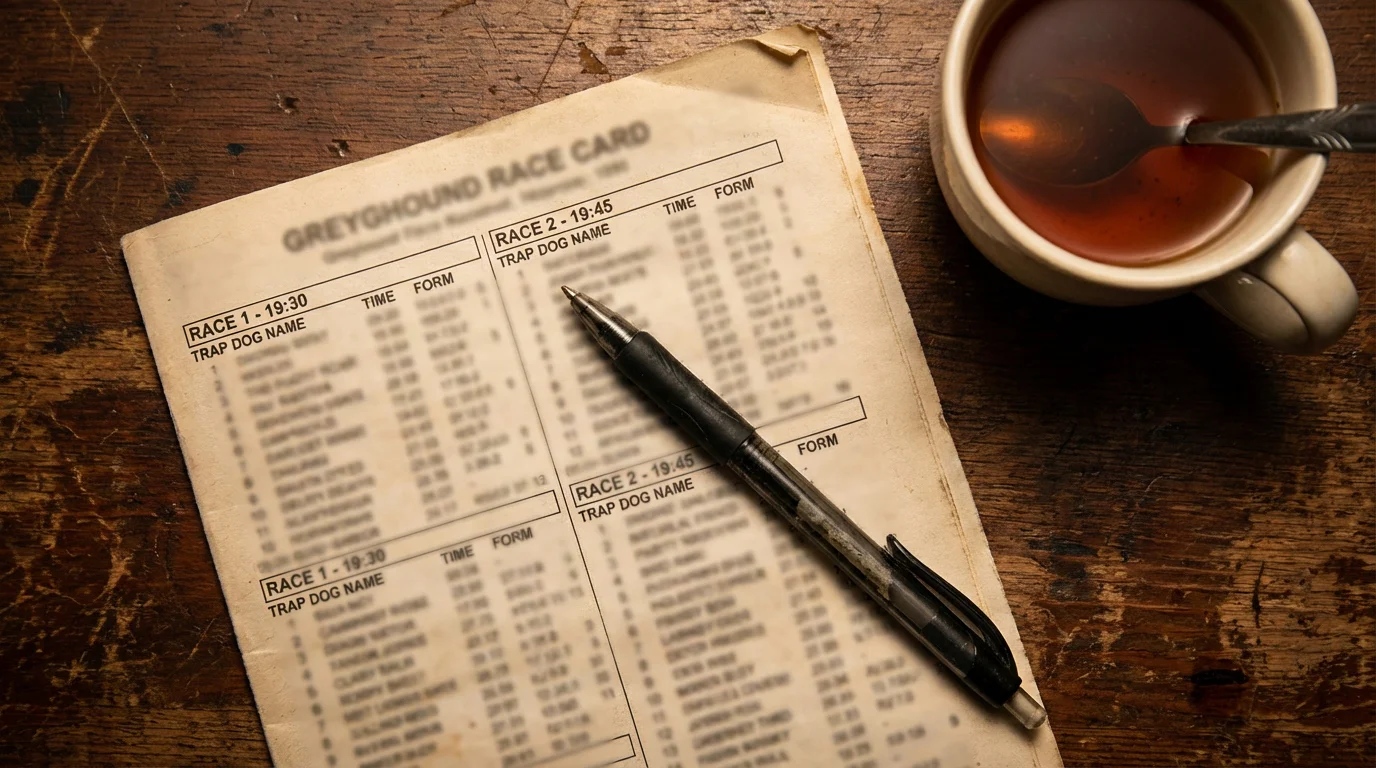
The Language of the Dogs
Greyhound racing has its own vocabulary, inherited from a century of track culture, betting shop shorthand, and regulatory language. Some terms cross over from horse racing. Others are specific to the sport. All of them appear on race cards, in form guides, on bookmaker platforms, and in the conversation of punters who have been going to the dogs long enough to forget that the language is not self-explanatory.
This glossary covers the terms a UK greyhound bettor needs to know — from the betting terminology that appears on every slip to the track and racing language that describes what happens between the traps and the finishing line. The definitions are practical, not academic. They explain what each term means in the context where you will encounter it: reading a race card, placing a bet, or interpreting a result.
Betting Terms: A to M
Accumulator. A single bet combining two or more selections across different races. All selections must win for the bet to pay out. The return from each winning leg rolls onto the next, compounding the payout. Also called an acca.
Ante-post. A bet placed on a greyhound event well in advance of the race — days or weeks before — typically on major competitions like the English Greyhound Derby. Ante-post bets usually offer longer odds but carry the risk that the selection may be withdrawn without a refund.
Best Odds Guaranteed. A bookmaker policy that pays the higher of the price you took and the starting price. If you back a dog at 4/1 and the SP drifts to 5/1, you are paid at 5/1. Commonly abbreviated to BOG. Not all bookmakers offer this on greyhound racing.
Computer Straight Forecast. The official dividend paid on a forecast bet when the payout is calculated by a formula based on the starting prices of the first two finishers, rather than being a fixed price agreed at the time of the bet. Abbreviated to CSF.
Dead heat. When two or more dogs cross the finishing line simultaneously and cannot be separated by the photo-finish camera. Winning bets on dead-heated dogs are settled at half the odds for a two-way dead heat, or a third for a three-way, reflecting the shared finishing position.
Double. An accumulator with two legs. Both selections must win. The return from the first leg becomes the stake on the second.
Each way. Two bets in one: a win bet and a place bet. If the dog wins, both parts pay out. If it finishes in a place position but does not win, the place part pays at a fraction of the win odds. Standard greyhound each-way terms in a six-dog field: first and second at a quarter of the odds.
Fixed odds. Odds agreed at the point of placing the bet and locked in regardless of how the market moves before the race. The opposite of starting price, where the payout is determined by the price at the time the traps open.
Forecast. A bet that names the first and second finishers. A straight forecast requires you to specify the exact order. A reverse forecast covers both permutations and costs twice the unit stake. A combination forecast covers multiple selections in all possible first-and-second arrangements.
Full cover bet. A bet that combines every possible single, double, treble, and accumulator from a set of selections. Examples include patents, Yankees, Lucky 15s, and Lucky 31s. Full cover bets offer partial returns from a single winner, unlike a naked accumulator which requires all legs to land.
Jolly. The favourite in a race — the dog with the shortest odds. Derived from older racing slang.
Lucky 15. A full cover bet on four selections comprising four singles, six doubles, four trebles, and one four-fold — fifteen bets in total. Typically carries a consolation bonus if only one selection wins.
Margin. The bookmaker’s built-in profit on a betting market, also called the overround. Expressed as the amount by which the implied probabilities of all runners in a race exceed 100 percent. A market with a 120 percent book carries a 20 percent margin.
Betting Terms: N to Z
Nap. A tipster’s most confident selection of the day. Originally from the card game Napoleon. When a greyhound tipster gives a nap, it is their strongest recommendation on the card.
Non-runner. A dog that is withdrawn from a race before the traps open. Non-runner rules vary by bookmaker: bets on named non-runners are typically voided and the stake returned. Bets placed on a trap number rather than a named dog may not be refunded if a reserve replaces the original runner.
Overround. The total implied probability of all runners in a market, which always exceeds 100 percent. A six-dog race where each dog’s odds imply a 20 percent chance produces a 120 percent overround — the 20 percent excess is the bookmaker’s theoretical margin.
Patent. A full cover bet on three selections: three singles, three doubles, and one treble — seven bets in total. A single winner returns something, unlike a treble which requires all three.
Place. A finishing position that qualifies for a payout on each-way or place-only bets. In standard six-dog greyhound racing, places are first and second.
Rule 4. A deduction applied to winning bets when a dog is withdrawn from a race after the market has formed. The deduction compensates for the reduced field and is scaled according to the withdrawn dog’s price. A 10p in the pound deduction means the payout is reduced by 10 percent.
Starting price. The official odds at the time the traps open, determined by the on-course betting market. Abbreviated to SP. The SP is used to settle bets placed at “starting price” and is the benchmark against which early prices and BOG offers are measured.
Straight forecast. A forecast bet that names the first and second finishers in the exact order. A correct prediction pays the CSF dividend. An incorrect order — even if both dogs finish in the first two — loses.
Tissue price. The bookmaker’s initial estimated odds for a race, compiled before the market opens. Tissue prices are the starting point from which the live market develops as money flows in.
Tote. The pool betting operator at greyhound tracks. Tote bets are aggregated into a pool, a percentage is deducted for the operator, and the remainder is divided among winning tickets. The payout is not fixed at the time of betting and depends on the total pool and the distribution of bets.
Treble. An accumulator with three legs. All three selections must win. The compounded return is the product of the three individual odds multiplied by the stake.
Tricast. A bet naming the first, second, and third finishers in exact order. A combination tricast covers all possible orderings of the selected dogs. Tricast dividends are typically larger than forecast dividends because the prediction is more specific.
Value. A bet where the odds offered are higher than the true probability of the outcome. A dog with a 25 percent chance of winning represents value at odds of 4/1 or longer, because the implied probability at 4/1 is 20 percent — less than the dog’s actual chance. Finding value is the foundational principle of profitable betting.
Void. A bet that is cancelled and the stake returned. Bets are voided when a race is abandoned, when a non-runner triggers a full refund, or when the conditions of the bet cannot be met.
Yankee. A full cover bet on four selections: six doubles, four trebles, and one four-fold — eleven bets total. No singles are included, so at least two selections must win for a return.
Track and Racing Terms
BAGS. Bookmakers’ Afternoon Greyhound Service. The commercial framework under which bookmakers fund daytime greyhound meetings for broadcast into betting shops and online platforms. BAGS meetings constitute the majority of greyhound racing fixtures in the UK.
Catching pen. The enclosed area at the end of the finishing straight where dogs are caught and secured after crossing the line. The catching pen’s design and padding affect post-race safety.
Flapper track. An independent greyhound racing venue that operates outside the GBGB licensing framework. Racing at flapper tracks is legal but unregulated: no mandatory drug testing, no official form database, and no requirement to meet GBGB welfare standards.
GBGB. Greyhound Board of Great Britain. The governing body of licensed greyhound racing in England and Wales. The GBGB sets the Rules of Racing, licenses tracks and trainers, enforces integrity and welfare standards, and publishes official form data.
Grading. The classification system that assigns dogs to races of appropriate standard. Grades run from A1 at the top to A10 or A12 at the bottom, depending on the track. Dogs are promoted after wins and demoted after sustained poor performance. Grades are track-specific — an A3 at one venue is not necessarily equivalent to an A3 at another. See the GBGB Rules of Racing for the full grading framework.
Hare. The artificial lure that runs on a rail around the outside of the track, ahead of the dogs. The mechanical hare was invented by Owen Patrick Smith around 1912, and oval-track greyhound racing was introduced to Britain in 1926.
Open race. A race unrestricted by grade, featuring the best dogs at the track competing against each other on merit. Open races are typically the feature events on an evening card and attract the deepest betting markets.
Sectional time. The time recorded from the traps to the first timing beam, usually positioned near the first bend. Sectional times measure a dog’s early speed and are the primary indicator of running style — fast sectionals indicate a front-runner, slow sectionals indicate a closer.
Seeding. The allocation of dogs to specific traps by the racing manager, based on their preferred running line. Railers are seeded toward Trap 1, wide runners toward Trap 6, and middle-track runners fill the remaining positions.
SIS. Sports Information Services. The media company that broadcasts live greyhound racing into betting shops and provides the streaming infrastructure for online platforms.
Trap colours. The standardised jacket colours that identify each starting position: Trap 1 red, Trap 2 blue, Trap 3 white, Trap 4 black, Trap 5 orange, Trap 6 black and white stripes.
The Vocabulary Pays for Itself
Greyhound racing does not require a specialist education, but it does require a shared language. The terms in this glossary appear on every race card, in every form guide, on every bookmaker platform, and in every conversation between punters and bookmakers at the track. Knowing them is not impressive. Not knowing them is expensive, because a misunderstood term leads to a misunderstood bet, and a misunderstood bet is one you did not intend to place.
The most important terms are the ones that directly affect your money: the bet types, the settlement rules, and the regulatory terms that determine how results are adjudicated. A punter who does not understand what Rule 4 means will be surprised by a deduction from a winning bet. A punter who does not know the difference between a straight forecast and a reverse forecast will pay twice what they expected. A punter who does not understand what SP means will not know whether BOG saved them money or cost them nothing.
The language is the entry fee. Pay it once, and the sport opens up. Skip it, and every race card, every odds display, and every settlement email remains partially opaque — a set of numbers and abbreviations that you can see but not fully read.