
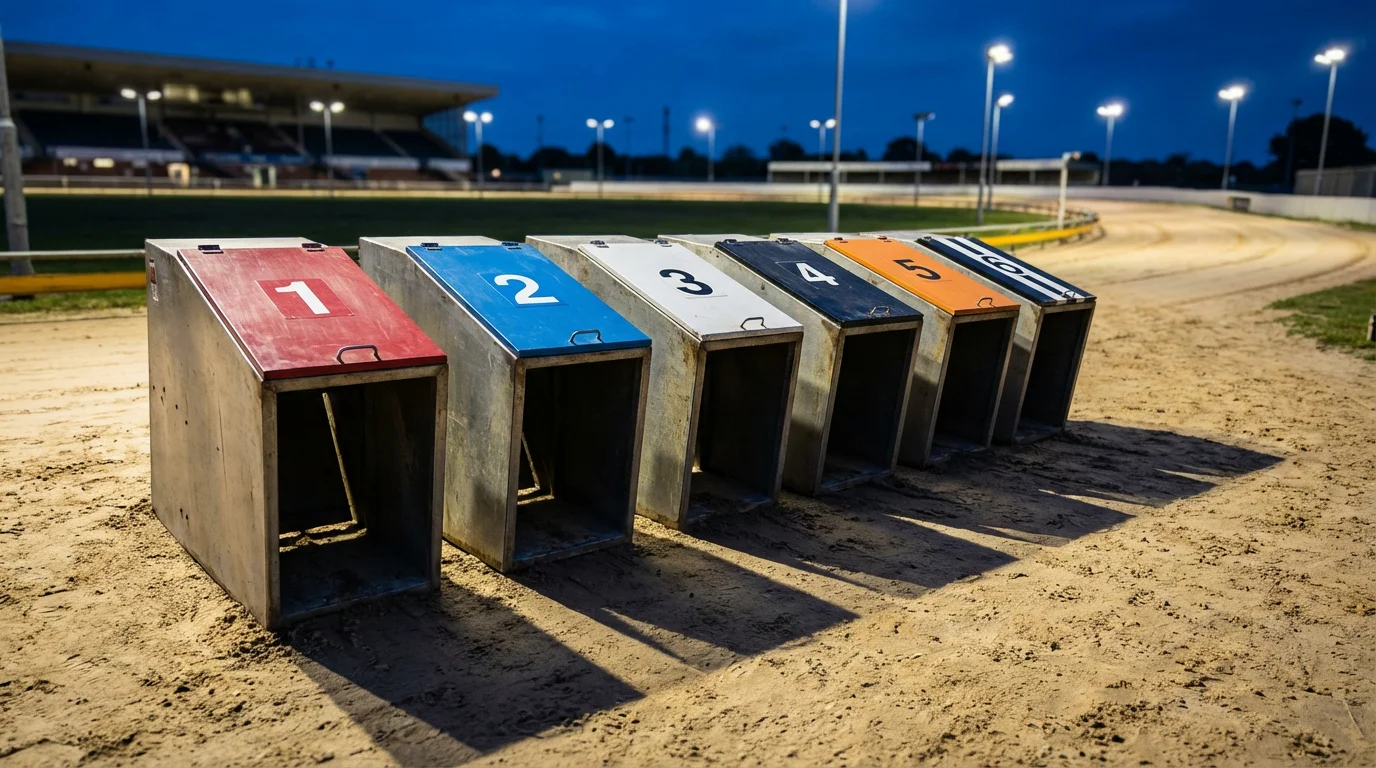
Six Traps, Six Colours, and a Bend That Decides Everything
The trap draw in greyhound racing assigns each dog a starting position numbered one through six, running from the inside rail outward. It is not a cosmetic detail. In a sport where races last 25 to 40 seconds and the first bend can determine the finishing order, the starting position is one of the most influential variables in the entire race — and one of the most underestimated by casual punters.
Every GBGB-licensed track in the UK has its own geometry: the angle of the first bend, the distance from traps to the turn, and the width of the running surface all differ. These physical properties create measurable biases. At some tracks, Trap 1 wins disproportionately because the inside line to the first bend is shortest. At others, wide runners from Trap 5 or 6 benefit from cleaner running room and less crowding. The bias isn’t random — it’s structural, persistent, and trackable through data.
Understanding trap draw starts with the colours. It continues with the physics. And it becomes useful only when you map both onto the specific track hosting the race.
Trap Colours and Positions
Each trap in UK greyhound racing is assigned a fixed colour, worn by the dog as a racing jacket. The colours are standardised across all tracks under GBGB Rule 118: Trap 1 is red, Trap 2 is blue, Trap 3 is white, Trap 4 is black, Trap 5 is orange, and Trap 6 is black and white striped. In races with seven or eight runners (rare in UK graded racing but historically possible in some open events — note that eight-dog races are no longer held at GBGB tracks), Trap 7 wears a green jacket, and Trap 8 wears a yellow and black jacket (as defined by GBGB Rule 118).
The colours serve a practical purpose — they allow spectators and trackside punters to identify dogs during the race without needing to recognise the animal itself. When six dogs are sprinting at 40 miles per hour around a bend, the jacket colour is often the only way to track your selection. Online and in betting shops, the trap numbers correspond to the same colour system, and race cards display both the number and the associated colour.
Trap positions are assigned by the racing manager based on each dog’s running style, previous performances, and the seedings for that meeting (as set out in GBGB Rule 76). In graded races, dogs are placed in traps that the racing manager considers appropriate — inside traps for dogs that rail well, wider traps for dogs that prefer room. This seeding introduces an element of informed placement, but it doesn’t eliminate bias. A dog that rails well may be drawn in Trap 1, but if that track’s Trap 1 consistently underperforms because the first bend is tight and early-pace dogs from wider traps cut across, the supposed advantage evaporates.
Trap Bias by Track
What the Statistics Show
Trap bias data is publicly available for all GBGB-licensed tracks and is published by several tipster and statistics services. The data records the win percentage for each trap over a defined period — typically a calendar year or a rolling 12 months. In a perfectly unbiased race, each trap would win approximately 16.7% of the time (one-sixth). Deviations from that baseline indicate structural bias.
The 2024-2025 data across UK tracks reveals persistent patterns. Trap 1 at Towcester has maintained a win rate of approximately 20% — more than three percentage points above the theoretical average. Over hundreds of races, that surplus represents a statistically significant edge for inside-drawn dogs. At the other end, Trap 6 at Harlow has shown similarly elevated win rates, at roughly 21%, suggesting that the wide draw carries an advantage at that specific track due to the geometry of the first bend and the ability of wide runners to find clear running room.
Other tracks show more balanced distributions. Newcastle’s trap percentages sit closer to the 16-17% range for most positions, suggesting a fairer track layout. Romford’s compact circuit produces slightly different patterns from Towcester’s longer layout. The data doesn’t lie — but it does need context. A 20% win rate from Trap 1 at one track doesn’t mean Trap 1 is universally advantageous. It means that specific track’s configuration favours the inside draw.
How to Use Trap Bias in Your Betting
The first step is knowing the bias data for the track you’re betting on. The second step — and the one most punters skip — is combining that data with the individual dog’s profile. A Trap 1 bias only benefits dogs that can exploit it. If your Trap 1 dog is a slow starter that tends to be crowded out of the first bend, the statistical advantage of the inside draw is irrelevant. Conversely, an early-pace dog drawn in a statistically weak trap may overcome the bias through sheer speed off the lids.
The practical approach is layered: check the trap bias data for the track, assess each dog’s running style and trap history, and then see whether the draw works with or against the dog’s natural tendencies. Punters who incorporate trap bias into their pre-race assessment routinely identify value that others miss — particularly in races where a dog’s price doesn’t reflect the draw advantage it holds.
One caution: trap bias data is aggregate. It describes a long-term tendency, not a guarantee for any individual race. Over 500 races, a 20% Trap 1 win rate is meaningful. In a single race, it’s one factor among many. Dogs don’t read statistics.
How Vacant Traps Change the Race
When a dog is withdrawn from a race, its trap is left empty. The remaining dogs still start from their assigned positions — there’s no reshuffling (as specified by GBGB Rule 73). This creates a gap in the line of traps, and that gap can materially alter the dynamics of the race, particularly at the first bend.
A vacant inside trap (Trap 1 or Trap 2) benefits the dog in the next occupied inside position. That dog now has more room on the rail and less crowding pressure into the first bend. If Trap 1 is vacant and Trap 2 holds an early-pace dog, that dog effectively inherits the inside running line without the usual first-bend squeeze. The advantage is real and is reflected in shorter prices for dogs adjacent to vacant traps — a pattern experienced punters and bookmakers both recognise.
A vacant outside trap (Trap 5 or Trap 6) has a different effect. It removes one potential wide runner, which can reduce interference for dogs in the middle traps but has less direct impact on the running line into the first bend. The middle traps (3 and 4) generally benefit the least from a single vacant trap unless the withdrawn dog was expected to create early-pace pressure.
In races with two or more vacant traps, the dynamics shift more dramatically. The remaining dogs have significantly more room, which tends to produce cleaner racing and can benefit strong runners that are usually hampered by crowding. Races with multiple non-runners are worth noting separately in your analysis, as the conditions are materially different from a full six-dog field.
Bookmakers adjust their prices when non-runners are declared, but not always by enough. The adjacent-trap advantage from a vacant position is sometimes undervalued in the market, creating an opportunity for punters who are paying attention to the declared runners in the minutes before the off.
The Draw Is Not Destiny — But It’s Close
Trap draw is one of those variables that separates punters who treat greyhound racing as a form of roulette from those who treat it as a craft. The information is available, the patterns are measurable, and the impact on race outcomes is documented. Ignoring the draw means ignoring a factor that explains between 3% and 5% of the variance in finishing positions at most UK tracks — a margin that, applied consistently over hundreds of bets, determines whether your betting account grows or shrinks.
Start with the data. Learn which traps carry advantages at the tracks you bet on most frequently. Then match the data to the dogs in front of you. The draw doesn’t win races on its own. But it shifts the probabilities — and probabilities, compounded over time, are where the money is.