
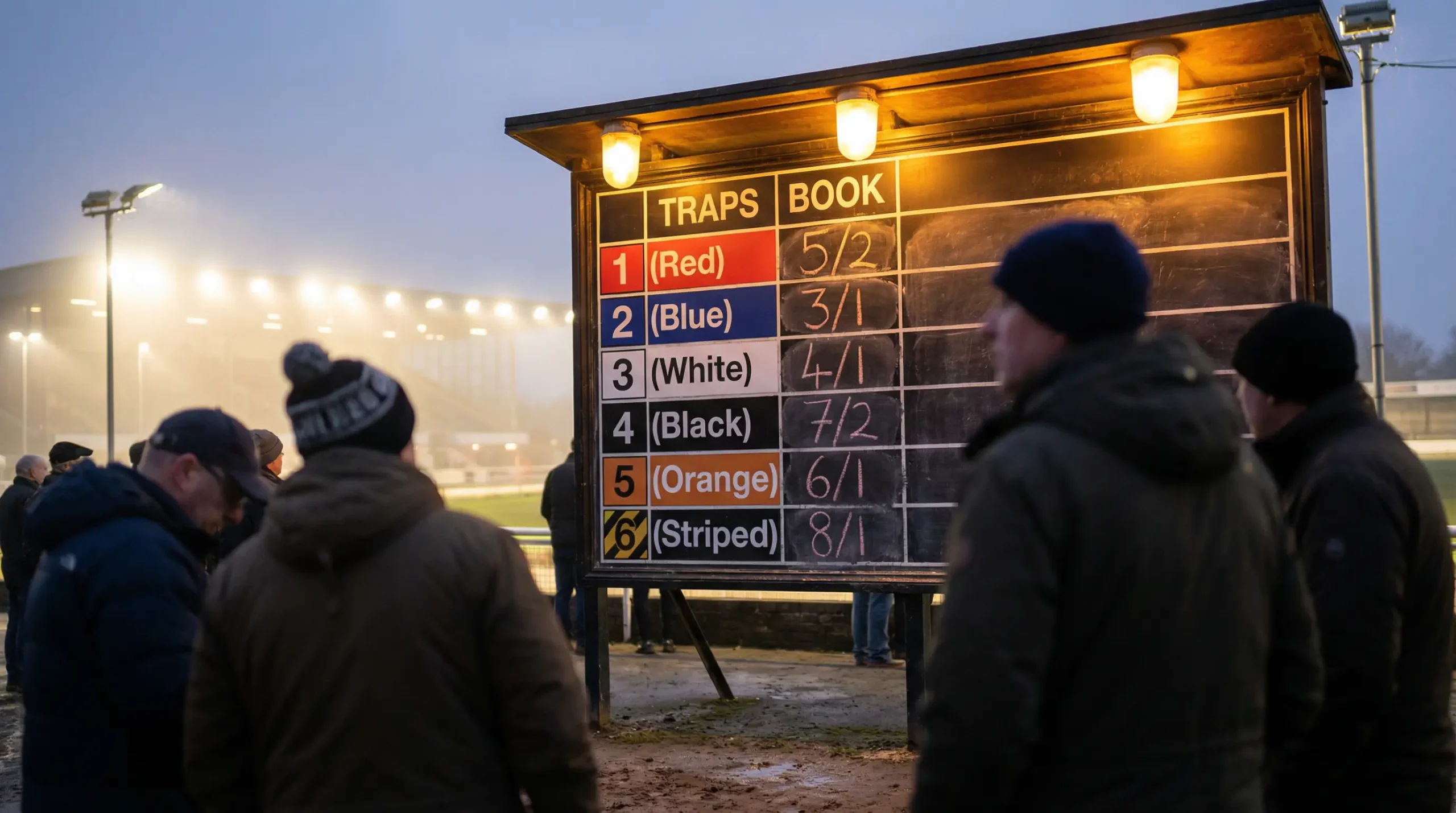
The Price on the Board Isn’t the Full Story
Greyhound odds work on the same fundamental principle as every other betting market — they represent the implied probability of an outcome, adjusted for the bookmaker’s margin. But the way those odds behave in practice, the speed at which they move, and the formats in which they’re presented carry nuances specific to dog racing that punters coming from horse racing or football betting need to understand.
In a six-dog race, the theoretical fair odds for any one dog winning are 5/1 (a one-in-six chance). In reality, no race works like that. Some dogs are faster, better drawn, or in superior form. The market reflects these differences by shortening the prices on fancied runners and lengthening them on the others. What distinguishes greyhound markets from most other sports betting is the speed and scale of these adjustments. Markets open and close within minutes. The window between early prices and the off is often no more than 15 to 20 minutes. For punters, this compressed timeframe concentrates all the value — and all the risk — into a narrow period of decision-making.
Understanding what the price tells you, how it’s expressed, and why it moves is the foundation of any structured approach to greyhound betting.
Fractional Odds Explained
How to Read Fractional Greyhound Odds
Fractional odds are the traditional UK format and remain the default at most greyhound tracks and in betting shops. They’re expressed as two numbers separated by a slash: the left number is your profit on a successful bet, the right number is the stake required to generate that profit. At 4/1, a £1 stake produces £4 profit plus the return of your £1 stake — a total of £5. At 4/6, you need to stake £6 to win £4 profit, returning £10 total.
The key to reading fractional odds fluently is recognising the implied probability. Odds of 2/1 imply a 33% chance. Odds of evens (1/1) imply 50%. Odds of 1/3 imply 75%. In greyhound racing, the favourite typically starts between 2/1 and 5/2, which tells you the market gives that dog roughly a 28-33% chance of winning. Given that there are six runners, a 33% implied probability means the favourite is seen as twice as likely to win as a random selection.
Where fractional odds become less intuitive is at non-standard fractions. A dog at 11/4 is harder to process mentally than 3/1, but the difference matters: 11/4 implies a 26.7% chance versus 25% for 3/1. At these margins, the ability to quickly convert between odds and implied probability separates informed punters from casual ones.
Odds-On Favourites in Small Fields
Greyhound racing produces odds-on favourites more frequently than horse racing. In a tight six-dog field where one dog is clearly superior, prices of 4/6, 8/11, or even shorter are common. At 4/6, you’re staking £6 to win £4. The implied probability is 60%, meaning the market believes this dog wins three out of every five times the race is run. Whether that represents value depends entirely on whether your own assessment of the dog’s chance exceeds that 60% threshold. If you believe the dog wins 70% of the time, 4/6 is a value bet. If you think it’s closer to 55%, it isn’t.
Decimal Odds and Starting Price
Decimal odds present the same information as fractional odds but in a format that includes the stake in the return figure. The fractional odds of 4/1 become 5.00 in decimal — your £1 stake returns £5 total. Odds of 4/6 become 1.67. Evens (1/1) is 2.00. The conversion is simple: divide the first number by the second, then add one. Most online bookmakers offer a toggle between fractional and decimal display, and an increasing number of punters — particularly younger ones — default to decimal because it makes return calculations faster.
Starting Price, or SP, is the price at which your bet is settled if you don’t take a fixed price when placing your wager. The SP is determined by the on-course market at the time the race begins — specifically, the prices being offered by on-course bookmakers at the track (as governed by GBGB Rules of Racing). In greyhound racing, the SP is set by the on-course market, which is typically smaller and less liquid than the off-course market. This can produce SPs that differ noticeably from the prices available online or in betting shops in the minutes before the race.
For punters betting online, taking a fixed price (also called an “early price”) locks in the odds at the moment you place your bet. If the dog’s price drifts (lengthens) before the off, you’ve secured a worse price than the SP will be. If it shortens, you’ve beaten the market. Best Odds Guaranteed, offered by many UK bookmakers on greyhound racing, resolves this dilemma: you take the early price, and if the SP turns out to be higher, you’re paid at the SP instead. It’s an asymmetric advantage for the punter and worth seeking out.
Why Greyhound Odds Move
Market movement in greyhound racing is driven by money. When significant stakes are placed on a particular dog, bookmakers shorten that dog’s price and lengthen others to manage their liability. In horse racing, this process unfolds over hours. In greyhound racing, it can happen in minutes.
The compressed timeline creates specific patterns. Early prices are set by bookmakers based on their own assessments — tissue prices — often influenced by the dog’s recent form, trap draw, and the track’s historical bias data. Once these prices go live, punter activity reshapes the market. A wave of money on Trap 2 will shorten that dog from, say, 3/1 to 2/1, while the less-backed dogs drift from 5/1 to 6/1 or beyond.
Significant market moves — called “steamers” when a dog shortens sharply or “drifters” when it lengthens — carry information. A steamer may indicate that well-informed punters have identified something in the form book that casual bettors have missed. A drifter may suggest that the dog’s paddock appearance, pre-race demeanour, or late news about a minor issue has reduced confidence. Neither signal is infallible, but both are worth noting.
Tote pools add another dimension. Because tote dividends are determined by pool size and distribution, the tote “odds” on a dog can diverge from the fixed-odds market. In small pools — common at afternoon meetings — a single large bet can dramatically shift the tote dividend. Punters who bet through the tote regularly learn to watch the pool totals as the race approaches, looking for situations where the tote is likely to pay more than the fixed-odds equivalent.
Where the Margin Hides
Every bookmaker’s market includes an overround — the margin built into the prices that ensures the operator profits regardless of the result. In a perfectly fair market for a six-dog race, the total implied probabilities of all runners would sum to 100%. In practice, they sum to more — typically 115-125% for greyhound racing, depending on the bookmaker and the race. That excess is the bookmaker’s margin.
A higher overround means worse value for punters across the board. An overround of 120% means that, on average, you’re paying 20% more for every unit of probability than a fair market would charge. Comparing overrounds between bookmakers for the same race identifies which operator is offering the best overall value, even if no single price stands out.
The overround is invisible if you only look at individual prices. It becomes visible when you convert every price to implied probability and add them up. Online calculators and betting tools make this trivial, and punters who routinely check the overround develop an instinct for when a market is tight (good value) and when it’s generous to the bookmaker (poor value). Greyhound markets, because of their smaller fields and faster turnover, tend to carry slightly lower overrounds than horse racing handicaps but higher ones than football match odds. The margin exists. Knowing where it sits is the first step to working around it.