
Two Ways In, Same Sport, Different Game
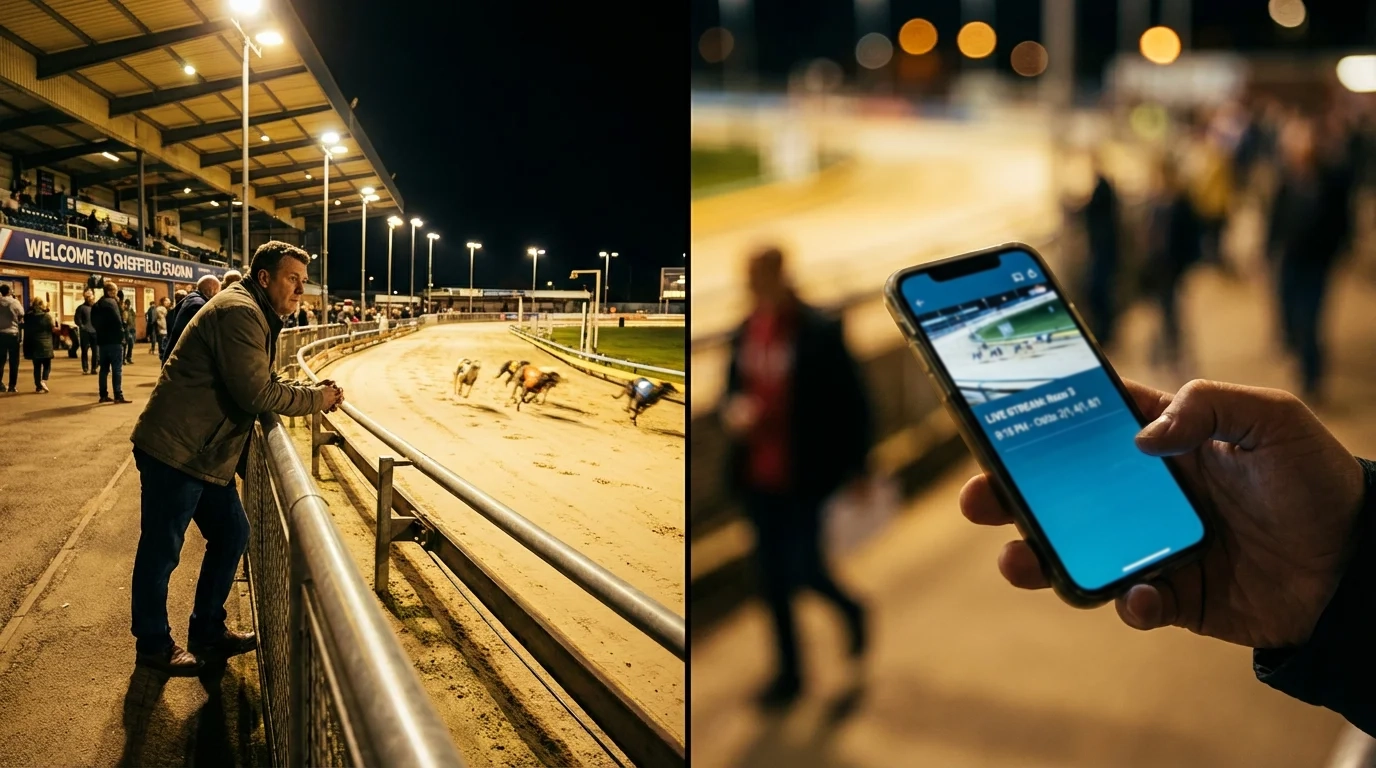
You can bet on greyhound racing without leaving your sofa or you can bet on it standing ten metres from the traps with sand dust on your shoes. The sport is the same. The betting experience is not. Online and on-course greyhound betting differ in the information available to you, the odds you are offered, the speed at which you can act, and the psychological pressures that shape your decisions. Choosing between them — or combining them — is not a trivial question. It determines the tools you have access to and the edges you can exploit.
The majority of greyhound betting in Britain now happens online. Bookmaker apps, live streaming, and instant odds comparison have shifted the centre of gravity away from the track and into the pocket. But on-course betting has not disappeared, and it retains informational advantages that no app can replicate. The parade ring, the physical condition of the dogs, the behaviour of the on-course market — these are data points that exist only at the track, and for the punter who knows how to use them, they are worth the admission price.
This is not a debate with a winner. It is a comparison of two platforms, each with strengths the other lacks, and the smartest approach may be to use both.
The On-Course Experience: What the Track Still Offers
On-course betting at a greyhound track is the oldest form of greyhound wagering and the one with the most direct connection to the racing itself. You are physically present. You can see the dogs in the parade ring before each race, assess their condition, watch how they behave in the kennels, and make judgements about their readiness that no camera feed fully captures. A dog that looks heavy, a dog that is agitated in the parade, a dog whose coat looks dull — these are signals that experienced on-course punters use to adjust their assessments, and they are invisible to the online bettor watching through a screen.
The on-course betting market operates through two channels: track bookmakers and the Tote. Track bookmakers set their own prices and display them on boards. The prices move as money comes in, and the experienced punter reads the market by watching which dogs attract early money and which boards adjust first. The Tote pools aggregate all bets and divide the pot among winners after deducting the operator’s percentage. The two markets often produce different prices on the same dog, and the on-course punter can choose whichever offers the better value — a luxury that requires physical presence.
The atmosphere of a live greyhound meeting adds a dimension that is difficult to quantify but real. The pace of the evening — the rhythm of races every fifteen minutes, the building tension as the traps are loaded, the eruption of noise as the hare passes — creates an immersive experience that a betting app cannot reproduce. For some punters, that atmosphere enhances enjoyment without affecting discipline. For others, it amplifies the emotional charge of betting in ways that can compromise decision-making. The social environment — friends, alcohol, the energy of a crowd — is part of the appeal and part of the risk.
The practical limitations of on-course betting are significant. You can only bet at tracks you can physically reach. Evening meetings mean travel time, parking, and a commitment of several hours. The range of tracks accessible to any individual punter is limited by geography, which restricts the volume and variety of racing you can cover. BAGS afternoon meetings, which provide the bulk of daily greyhound racing, run with minimal or no public attendance, so on-course betting during the day is rarely an option. The on-course punter is limited to evening meetings, weekends, and the occasional feature event — a fraction of the total fixture programme.
Odds comparison is also constrained. At the track, you see the prices offered by the bookmakers present and the Tote dividend projections. You do not see the prices available across a dozen online operators simultaneously. The competitive tension between three or four on-course bookmakers is real, but it is narrower than the market-wide competition that online betting produces. The on-course punter may get a better price than any single online bookmaker, or may miss a better price available elsewhere. Without a phone in hand, there is no way to know.
Online Betting: Speed, Data, and the Price War
Online greyhound betting gives you access to every BAGS meeting, every evening card, and every fixture on the GBGB circuit from any location with an internet connection. The coverage is comprehensive: live streaming through bookmaker apps, real-time odds updates, and form databases that provide sectional times, trap statistics, and historical results stretching back years. The informational environment is richer than anything available on-course, and the speed at which you can analyse, decide, and execute a bet is limited only by your own processing time.
Odds comparison is the single most significant advantage of online betting. A punter with accounts at four or five bookmakers can compare prices on the same dog in seconds, take the best available odds, and benefit from promotions — best odds guaranteed, enhanced each-way terms, accumulator bonuses — that no on-course bookmaker offers. The competitive pressure between online operators is intense, and it manifests as tighter margins and more frequent promotional offers. Over hundreds of bets, consistently taking the best available price rather than accepting whatever a single bookmaker offers produces a measurable difference in returns.
The data advantage extends beyond odds. Online form services provide analytical tools that would have been inaccessible to the average punter a generation ago: trap bias tables by track, distance, and surface condition; sectional time rankings; trainer strike rates at individual venues. The punter who uses these tools has access to the same raw material as the bookmaker’s own traders. The edge comes not from having exclusive information but from interpreting the publicly available data more accurately than the market price reflects.
The drawbacks of online betting are less obvious but equally real. You lose the physical assessment of the dogs — no parade ring, no visual check, no opportunity to spot that a fancied runner looks below par. You lose the market-reading signals that come from watching on-course bookmakers react to money in real time. And you gain a frictionless environment that makes it extraordinarily easy to bet quickly, frequently, and without the natural pauses that physical attendance imposes. An evening at the track has a finite number of races. An evening on a betting app has as many races as you are willing to watch, from as many tracks as are running, with no one asking whether you should stop.
The speed of online betting is a tool and a trap. A punter with discipline uses it to execute a pre-analysed bet at the optimal price in the closing minutes before the off. A punter without discipline uses it to chase losses across three simultaneous meetings on a Tuesday afternoon. The platform does not distinguish between the two. It processes both bets with identical efficiency, and the absence of social friction — no queue at the bookmaker’s window, no visible exchange of cash — removes the small physical barriers that slow impulsive decisions.
The Hybrid Approach: Using Both to Your Advantage
The punter who treats on-course and online as mutually exclusive is leaving information on the table. The most effective approach combines the physical intelligence of the track with the analytical and pricing advantages of the online market. Attend the meeting. Watch the parade. Assess the dogs. Then place the bet on your phone at the best available price across the online market. You get the data from both environments and the best odds from whichever channel offers them.
The hybrid approach works particularly well at evening meetings where the fields are competitive and the betting markets are deep. The on-course punter who spots a dog looking below par in the parade can downgrade that runner in their assessment before the market has priced the observation in. If the dog remains a short price online because the screen-only punters cannot see what the parade revealed, the hybrid punter can act on the discrepancy — laying the dog on an exchange, backing an alternative at inflated odds, or simply avoiding a losing bet that the form alone would have suggested.
Track attendance also builds the experiential knowledge that improves online-only analysis. A punter who has stood at Romford and watched how races unfold at the first bend — the compression of the field, the rail advantage, the way wide runners lose ground on the tight turns — understands the track’s racing dynamics in a way that a statistical table cannot fully convey. That understanding informs every subsequent online bet on a Romford race, even when the punter is watching from home. The track visit is an investment in knowledge that pays dividends long after the evening is over.
The practical constraint is time. Not every punter can attend live meetings regularly, and the tracks are not distributed evenly across the country. A punter in the north of England has access to different venues than one in London, and the frequency of attendance depends on geography, schedule, and personal circumstance. The hybrid approach is ideal but not always feasible. For the punter who cannot attend, the online environment provides everything necessary to bet analytically and profitably. The track visit is an enhancement, not a requirement.
The Screen and the Sand Are Not the Same Thing
On-course betting gives you proximity. Online betting gives you breadth. Neither gives you everything, and the punter who pretends otherwise is ignoring a gap in their toolkit. The track offers sensory data and market signals that a livestream strips away. The app offers analytical depth and pricing competition that the trackside bookmaker cannot match. Each environment rewards a different set of skills and exposes you to a different set of risks.
The direction of the sport is toward online. Attendance at most tracks continues to decline, and the commercial model increasingly depends on broadcast revenue rather than gate receipts. But the tracks are still open, the dogs still parade, and the on-course market still sets prices that reflect information the digital market has not yet absorbed. For as long as that remains true, the punter who understands both environments — and uses each for what it does best — holds an advantage over the punter who knows only one.
Choose the platform that fits your circumstances. If you can get to the track, go. If you cannot, the online market gives you everything you need to bet with discipline and intelligence. But do not mistake convenience for completeness. The screen shows you the race. The sand shows you the sport.