
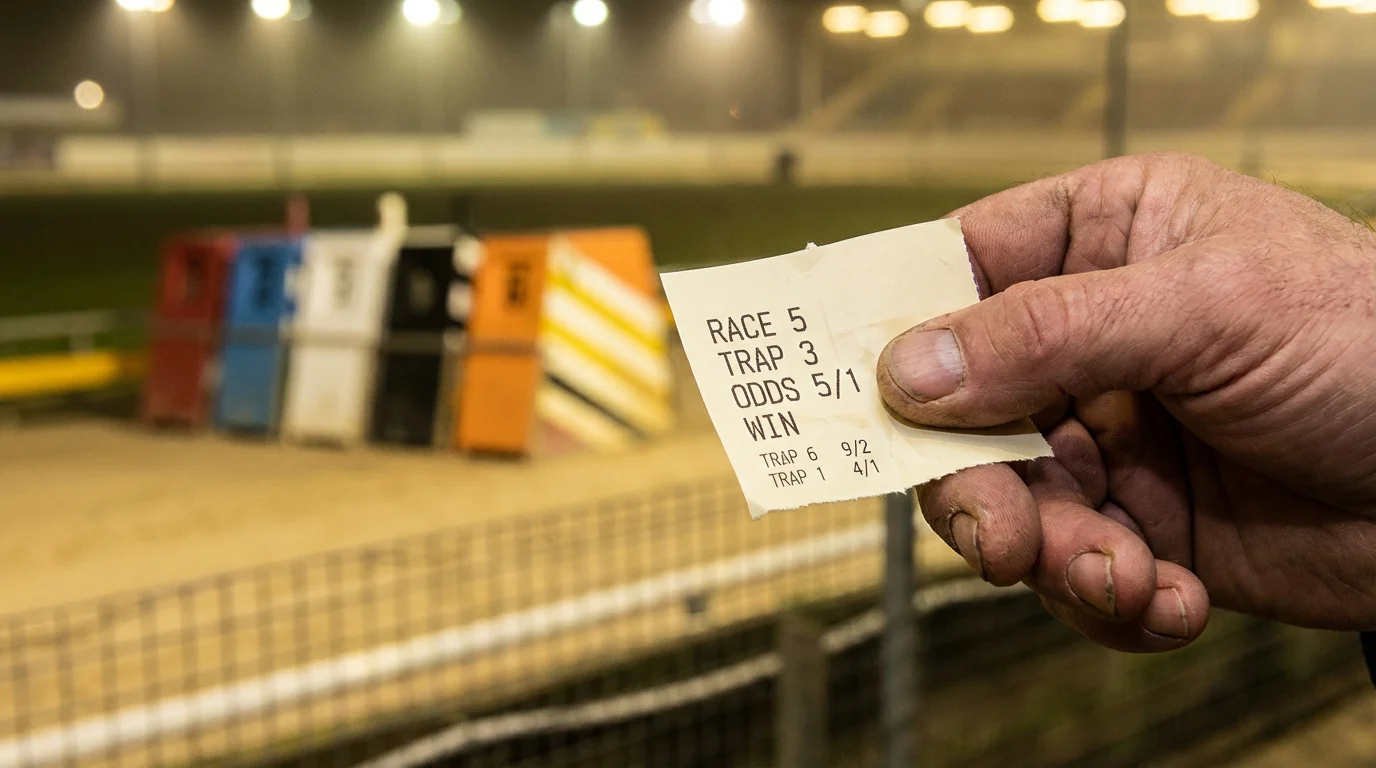
Fewer Dogs, Fewer Markets, Sharper Decisions
A six-dog race does not need thirty bet types — but the ones it does offer carry more edge than most punters realise. Greyhound racing produces a constrained set of possible outcomes: six runners means six possible winners, thirty possible first-and-second combinations, and one hundred and twenty possible first-second-third sequences. Compare that to a sixteen-runner horse race and the maths alone explains why greyhound markets are structurally different. The fields are smaller, the permutations are fewer, and the probability of any single outcome is higher.
That structural advantage is available to every punter. The question is whether you use the right bet type to exploit it. A win bet on a 2/1 favourite is a different proposition from a forecast combining that favourite with a specific second-place finisher. Each market — win, each way, forecast, tricast, Tote pool, accumulator — captures a different slice of the probability space, and each comes with its own risk-reward profile, its own bookmaker margin, and its own strategic logic.
Most casual punters use one bet type — usually a win single — and never consider the alternatives. That is not necessarily wrong. A win bet is clean, easy to evaluate, and transparent in its maths. But it is also the market where the bookmaker’s pricing is most efficient, because it is where the most money flows and where the most analytical attention is directed. The less popular bet types — forecasts, tricasts, pool bets — are priced with less precision, and that is where the opportunities for the informed punter tend to sit.
This guide works through every bet type available to UK greyhound punters. It explains how each one works, when each one makes sense, and when it does not. The aim is not to recommend a single approach but to give you a complete understanding of your options, so that the choice of bet type becomes a deliberate decision rather than a default.
Win Bets: The Simplest Wager in Greyhound Racing
A win bet asks one question: will this dog cross the line first? If it does, you collect at the agreed odds. If it finishes second, third, or anywhere else, you lose your stake. There is no consolation, no partial return, no place element to soften the blow. The simplicity is the appeal, and for many punters, the win single is the only greyhound bet they ever place.
The win market on a six-runner greyhound race is the most liquid and most efficiently priced of all greyhound betting markets. Bookmakers devote their sharpest attention to setting the win odds because it is the market that attracts the most money and where their exposure is greatest. The overround — the combined implied probability of all six dogs, which always exceeds 100 percent to give the bookmaker a margin — is typically between 115 and 125 percent on a greyhound win market. That margin is wider than football or tennis, but narrower than many exotic bet types within greyhound racing itself.
The strategic considerations for a win bet are straightforward. You need the dog to be the outright winner, so you are looking for the runner with the highest probability of finishing first, relative to its price. A dog at 3/1 needs to win more than 25 percent of the time to represent value. A dog at 7/2 needs to win more than about 22 percent. The maths is simple enough to do mentally, and the discipline is applying it honestly rather than backing dogs because you like their name or their trap colour.
Win bets work best when you have a strong opinion about the winner. If you have identified a dog that you believe has been underpriced — perhaps a recent demotion that masked unlucky form, or a fast breaker drawn in Trap 1 at a track with heavy inside bias — a win single captures your conviction with maximum simplicity and minimum cost. You stake once, on one outcome, at one price. If your analysis is correct, the return is clean. If it is wrong, you know exactly what it cost you.
Where win bets are less effective is in competitive races where you cannot separate two or three contenders with confidence. Backing one dog to win when you genuinely think two others have similar chances is a decision driven by market mechanics rather than form conviction. In those situations, the other bet types earn their place.
Each-Way Bets on Greyhounds
Each-way changes the equation — you are no longer betting on perfection. An each-way bet is two bets in one: a win bet at the full odds and a place bet at a fraction of the odds. If the dog wins, both parts pay out. If the dog finishes in a place position but does not win, the place part pays and the win part loses. If the dog finishes outside the places, both bets lose. The total stake is double what you might expect: a £5 each-way bet costs £10, because the win part and the place part are each £5.
The place terms determine the fraction of the odds paid for a placed finish. In greyhound racing, the standard each-way terms for a six-runner race are first and second at a quarter of the odds. A dog at 8/1 each way pays 8/1 for a win and 2/1 for a place. A dog at 4/1 each way pays 4/1 for a win and evens for a place. These terms are standard across most bookmakers, though it is worth checking because some operators offer enhanced each-way terms as a promotion.
Place Terms by Field Size
Field size affects each-way terms. In a standard six-dog race, places are paid on the first two finishers at a quarter of the win odds. If the field is reduced to five runners — typically because of a late withdrawal — some bookmakers adjust the terms. The places may remain at two but the fraction drops to a fifth of the odds, or the number of paying places may reduce to one, effectively making the each-way bet a win-only proposition with a redundant place element.
The reduction in field size also affects the overall value of each-way betting. In a five-dog race, the probability of any single dog placing in the first two is 40 percent purely by random chance. At those odds, the place part of an each-way bet carries less value because the likelihood of placing is already high without any form analysis. The bookmaker adjusts for this by tightening the fraction, which compresses the place return. In small fields, each-way betting becomes less attractive, and win singles often represent better value.
When Each-Way Offers Value — and When It Doesn’t
Each-way value depends on the relationship between the win odds and the place probability. The sweet spot is a dog at medium odds — roughly 5/1 to 10/1 — that has a realistic chance of placing even if winning is uncertain. At these prices, the place return is large enough to cover the combined win-and-place stake, meaning a placed finish returns a profit rather than just minimising the loss.
Consider a £5 each-way bet at 8/1. Total outlay: £10. If the dog places, the return is £5 at 2/1 plus the £5 stake back, totalling £15. That is a £5 profit despite the dog not winning. The each-way bet has turned a non-winning selection into a positive outcome, which is the entire point of the mechanism.
At short odds, each-way collapses. A dog at 2/1 each-way pays 1/2 for a place. A £5 each-way bet at 2/1 costs £10 total. If the dog places but does not win, you receive £5 at 1/2 plus the £5 stake, totalling £7.50 — a £2.50 loss on a £10 outlay. The place return does not cover the total stake, so even a placed finish costs you money. At short prices, you are better off either backing to win at the full price or reducing your stake.
At very long odds — 12/1 and above — each-way can work if you genuinely believe the dog has a placing chance. The place return at quarter odds is generous: 3/1 for a dog priced at 12/1. But the danger is backing outsiders each way purely because the place terms look attractive, without a genuine view that the dog will be competitive. The bookmaker has priced the dog at 12/1 for a reason, and if that price accurately reflects its chance, the each-way bet loses more often than the occasional placed return can compensate for.
Forecast Bets: Naming the First Two
The straight forecast is where greyhound betting starts to reward genuine knowledge. A forecast bet requires you to predict the first and second finishers in a single race, in the correct order. In a six-dog race, there are thirty possible first-and-second combinations. Your straight forecast singles out one of those thirty as the most probable, and if you are right, the return reflects the difficulty of the prediction.
Forecast dividends on greyhound racing are calculated using either the computer straight forecast formula — a mathematical model that derives the dividend from the starting prices of the first and second — or a fixed-odds price offered by the bookmaker. The CSF dividend varies by race and is announced after the result, based on the SPs of the placed dogs. It can produce returns ranging from a few pounds to several hundred, depending on the prices of the two dogs involved.
Straight Forecast vs Reverse Forecast
A straight forecast names the first and second in exact order: Dog A to win, Dog B second. If Dog B wins and Dog A is second, you lose. The specificity is what generates the larger returns, but it also means you need conviction about the finishing order, not just the two most likely place finishers.
A reverse forecast covers both permutations: Dog A first and Dog B second, or Dog B first and Dog A second. It is two bets in one, so the stake doubles. A £5 reverse forecast costs £10. The benefit is flexibility — you do not need to call the order, just the two dogs. The trade-off is that the doubled stake reduces the net profit. If the CSF dividend for one permutation is £30, your £10 reverse forecast returns £30, not £60, because only one of the two bets won.
The choice between straight and reverse depends on your confidence in the finishing order. If the race has a strong front-runner in Trap 1 that you expect to lead throughout, and a confirmed closer that typically picks up places, the order is predictable and a straight forecast captures the full value. If two dogs of similar ability are drawn together and either could finish ahead of the other, the reverse forecast is the pragmatic choice, paying a premium for flexibility.
Combination Forecasts and Multi-Race Forecast Doubles
A combination forecast extends the concept to three or more selections. If you believe three dogs — A, B, and C — are the most likely to fill the first two places, a combination forecast covers all six possible first-and-second permutations: AB, BA, AC, CA, BC, CB. The stake is six times the unit. A £1 combination forecast on three dogs costs £6.
This approach is useful in races where you can narrow the likely placed finishers to a subset of the field but cannot separate them clearly. In a six-dog race where two dogs are clearly outclassed and the remaining four are competitive, a combination forecast on the four live contenders covers twelve permutations at £12 per unit. That is expensive, but if the CSF dividend is generous — which it often is when mid-priced dogs fill the first two — the return can comfortably exceed the outlay.
Forecast doubles link two straight forecasts across two separate races into a single bet. Both must win for the bet to pay. The odds compound: a £5 forecast double combining a CSF of £20 in race one and £15 in race two returns a substantial sum, but both forecasts must be correct. These bets carry high risk and high reward, and they suit punters who have identified strong forecast opportunities on the same card and want to maximise the return from their convictions.
Tricast Bets: Predicting the Top Three
In a six-dog field, predicting the first three in order means picking one sequence from one hundred and twenty possible permutations. The tricast is the most ambitious standard bet type in greyhound racing, and its dividends reflect that ambition. A successful tricast on a six-runner greyhound race routinely returns multiples of the stake that no other single-race bet type can match.
A straight tricast names the first, second, and third finishers in exact order. A combination tricast covers all possible orderings of your selected dogs. Three selections produce six permutations, so a £1 combination tricast costs £6. Four selections produce twenty-four permutations at £24 per unit. The cost escalates quickly, which means combination tricasts need substantial dividends to justify the outlay.
The computer tricast formula, like the CSF, derives the dividend from the SPs of the first three. Dividends in the hundreds are common when an outsider fills one of the three places. Dividends in the thousands are not unheard of. The variance is high, which means tricast betting is streaky: long losing sequences punctuated by occasional large returns. It is a bet type that demands a specific temperament — patience with the losses and discipline with the stakes.
Tricast betting is most productive when you can eliminate dogs from contention rather than predicting exact placings. If you are confident that two dogs in the race have no realistic chance of finishing in the first three, the remaining four dogs produce twenty-four permutations for a combination tricast. That is expensive at £1 per permutation, but the approach works because the dividend is calculated against all six runners. Your effective pool of contenders is four, but the payout is calibrated for a six-dog race — a structural advantage that improves your expected return.
The danger with tricasts is treating them as lottery tickets. A random tricast on every race is a guaranteed way to lose money over time because the bookmaker margin on the tricast market is wider than on win or forecast bets. Tricasts work for the punter who has a view on the race, uses elimination to narrow the field, and manages the stake so that long losing runs do not deplete the bankroll before a big dividend arrives.
Tote and Pool Bets
Pool betting disconnects you from fixed odds — your payout depends on what everyone else did. The Tote pools at greyhound meetings aggregate all bets into a single fund, deduct a percentage for the operator, and divide the remainder among winning tickets. The result is a payout that is unknown at the time of betting and can be significantly higher or lower than the equivalent fixed-odds return.
The Tote win pool is the simplest: all win bets go into the pot, the operator takes its cut — typically between 15 and 25 percent — and the remainder is divided by the number of winning units. If the pool is £1,000, the take is 20 percent, and sixty units backed the winner, each unit wins £13.33. That might be better than the fixed-odds SP or worse, depending on how the money was distributed across the field.
Tote exacta and trifecta pools mirror forecast and tricast bets in their structure but differ in their pricing. Because the dividend is determined by the pool rather than by a formula applied to SPs, the exacta and trifecta dividends can diverge substantially from their fixed-odds equivalents. A popular combination that many punters backed will pay less via the Tote than via the CSF. An unpopular combination that few punters found will pay more. The Tote rewards contrarian thinking: if your forecast or tricast differs from the crowd’s favourite combination, the Tote is where that difference pays best.
Jackpot pools — requiring winners in multiple consecutive races — offer the largest potential returns in greyhound pool betting. The jackpot typically demands the winner of six races, and rollover pools from previous meetings can push the total to figures that dwarf anything available through fixed-odds betting. The probability of hitting a six-race jackpot is, of course, extremely low. These pools are entertainment for most punters and a mathematical exercise for the few who approach them with syndicate-level analysis and bankrolls to match.
Pool betting suits a specific type of punter: one who is comfortable with unknown payouts, who enjoys the communal aspect of competing against the pool rather than the bookmaker, and who sees value in being on the unpopular side of a market. For most, the Tote is an occasional alternative to fixed odds. For a few, it is a primary market with structural advantages that fixed-odds betting cannot replicate.
Accumulator and Multiple Bets
An accumulator chains selections across races — and the maths compounds fast. A double links two selections: if both win, the return from the first is rolled onto the second, producing a combined payout that exceeds either single bet. A treble links three. A four-fold links four. The progression continues, and at each stage, the potential return multiplies while the probability of success diminishes.
The appeal is obvious. A £5 treble on three dogs at 3/1, 4/1, and 5/1 returns £600 if all three win. The same £5 spread across three singles at those prices returns a combined £75 if all win and something less if only one or two oblige. The accumulator concentrates all the value into a single, all-or-nothing outcome, and the headline returns are large enough to make the bet feel transformative.
The reality is more sobering. The probability of a three-leg accumulator winning, even with relatively short-priced selections, is low. Three selections each with a 33 percent win probability combine to give the accumulator a 3.6 percent chance of paying out. That is roughly one in twenty-eight. For a four-fold at similar individual odds, the probability drops to about 1.2 percent — roughly one in eighty-three. The returns look spectacular because the probability of achieving them is very small.
Bookmakers encourage accumulator betting for precisely this reason. The margin compounds with each leg: if the bookmaker’s edge on a single bet is 5 percent, the effective margin on a four-fold is roughly 18.5 percent. The more legs you add, the more the arithmetic favours the operator. Acca boosts and bonus offers — common promotions that add a percentage to the return — offset a fraction of this compounding margin, but they do not eliminate it.
Accumulators have a place in a punter’s repertoire, but that place is small. They work as occasional speculative bets when you have strong convictions across multiple races and want to amplify the return. They do not work as a core staking strategy because the strike rate is too low and the margin too wide. The punter who bets three accas every night at the dogs is funding the bookmaker’s margin more efficiently than almost any other approach available. If you build accas, build them infrequently, build them with selections you genuinely believe in, and stake them at a level where a loss is immaterial.
Full cover bets — patents, Yankee bets, Lucky 15s — offer a middle ground by combining accumulators with the underlying singles, doubles, and trebles. A patent on three selections is seven bets: three singles, three doubles, and a treble. If only one selection wins, the single pays and partially offsets the total stake. The coverage comes at a higher cost — a £1 patent is £7, a £1 Yankee on four selections is £11 — but the chance of a total wipeout is reduced. In greyhound racing, where individual race results are volatile and no selection is a certainty, full cover bets offer more resilience than naked accumulators for the punter who wants multiple-race exposure without the all-or-nothing profile.
Pick Your Weapon Wisely
Every bet type is a tool — and the wrong tool for the job costs more than no tool at all. A win single on a dog you have studied carefully is a sharper instrument than a tricast thrown at a race you glanced at. An each-way bet at the right price is a smarter play than a straight forecast when you cannot separate the first two. The skill is not in knowing how each bet type works — that is the mechanics, and the mechanics are straightforward. The skill is in matching the bet type to the specific opportunity.
The best greyhound punters use different bet types for different situations. They back to win when their conviction is in a single dog. They use forecasts when they can see the probable first and second but the win bet undervalues the opportunity. They take each-way when the place return justifies the double stake. They leave tricasts for the rare occasions when the race shape is clear enough to narrow the first three with confidence. They build accumulators sparingly and only when the individual selections would have been backed anyway.
What they do not do is default to the same bet type regardless of the race. A punter who bets win singles on every race is leaving money in the forecast market. A punter who bets tricasts on every race is bleeding money through variance. The market rewards specificity — the willingness to choose the right bet for the right moment and the discipline to pass when no bet type fits the opportunity. The bet types are all available, all the time. The punter’s job is knowing which one to reach for.