
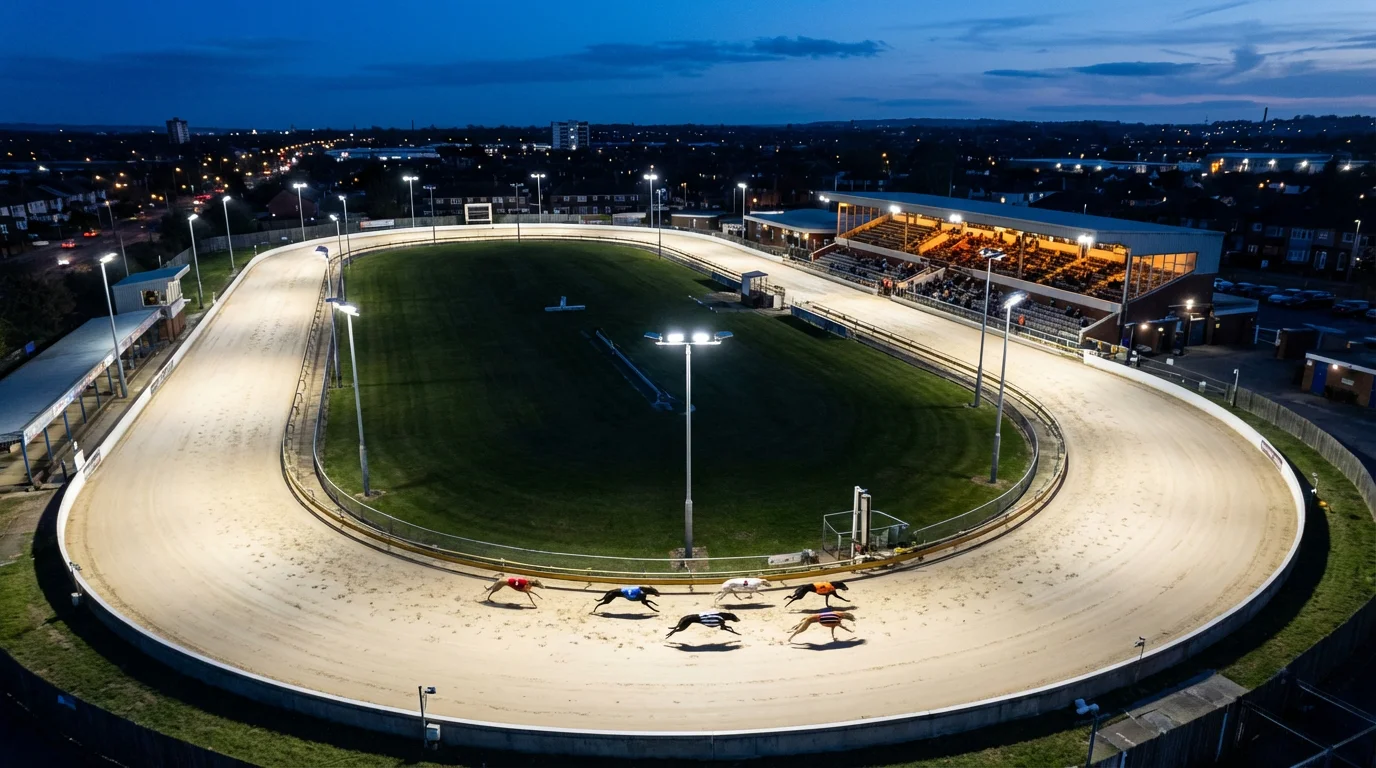
Around Twenty Tracks, One Regulated Circuit
The GBGB map of licensed tracks in 2026 looks nothing like it did twenty years ago. In the mid-2000s, more than thirty stadiums held regular fixtures under the sport’s governing body. Today, the number sits at around twenty — the exact count fluctuating as venues close and, occasionally, new ones open — and the trajectory has been consistently downward. Stadiums have closed for redevelopment, financial pressure, or both, and the geography of UK greyhound racing has contracted into a smaller, more concentrated footprint that is overwhelmingly weighted towards London, the Midlands, and the south-east of England.
For the bettor, the track map is not just a matter of geography. Each stadium has its own dimensions, its own surface characteristics, its own trap bias profile, and its own competitive ecosystem of dogs, trainers, and grading standards. A dog that wins comfortably at Romford may struggle at Towcester. A form line from Monmore does not translate directly to Sunderland. Understanding these differences is not an academic exercise — it is a practical necessity for anyone who bets across multiple venues or follows dogs that transfer between tracks.
The Greyhound Board of Great Britain licenses and regulates the stadiums on its circuit. A licensed track operates under the GBGB Rules of Racing, employs stipendiary stewards, conducts drug testing, and publishes official race results and form data. This regulatory framework is what makes systematic form analysis possible. Without it, the data does not exist, the integrity mechanisms are absent, and the punter is operating blind.
This guide profiles the licensed stadiums by region, covers the practical differences between venues, and explains what the ongoing programme of closures means for the punter who relies on a healthy circuit to supply the racing that betting requires.
London and South-East Tracks
London’s relationship with greyhound racing has contracted from fifteen tracks to two. The capital that once supported White City, Wimbledon, Walthamstow, Catford, and a string of other stadiums now relies on Romford and Crayford to carry the flag for the sport in the south-east. The closures were driven almost entirely by the value of the land those stadiums sat on. A greyhound track in Zone 3 or 4 of London occupies real estate that developers will pay multiples of what the sport can generate in revenue, and the economics resolved themselves in the inevitable direction.
Romford, Crayford, and the Capital’s Surviving Stadiums
Romford, in the London Borough of Havering, is the capital’s premier greyhound venue and one of the best-known tracks on the entire GBGB circuit. Its compact oval produces racing that rewards early pace and clean trapping, with a pronounced inside trap bias at sprint distances that informed punters build their analysis around. Evening meetings at Romford generate deep betting markets and attract competitive fields, making it one of the most productive tracks for systematic form-based betting. The sprint programme — centred on the 400-metre dash — is the track’s signature, and the specialist sprint dogs that race here are among the sharpest in the country.
Crayford, in the Borough of Bexley, complements Romford by offering a slightly different racing character. The track is a standard four-bend circuit with dimensions that produce less extreme trap bias than Romford’s tighter configuration. Crayford hosts regular BAGS fixtures that supply the daytime betting market and evening meetings that draw competitive fields from the south-east kennel population. The track has been a consistent fixture on the circuit for decades, and its survival — in a region where land values have driven multiple closures — reflects a combination of loyal patronage, sensible management, and the commercial reality that the south-east needs at least two active stadiums to maintain a viable racing programme.
The loss of Wimbledon in 2017 was the most significant closure in modern greyhound racing history. The stadium had hosted the English Greyhound Derby and was the sport’s flagship venue, known internationally and synonymous with the highest quality of competition. Its closure to make way for the AFC Wimbledon football stadium removed not just a track but a symbol. The Derby relocated to Towcester, and the south-east lost a venue that no replacement could fully replicate in terms of prestige, history, or emotional weight within the greyhound community.
For the punter focused on London tracks, the practical consequence is specialisation. With only two venues operating regularly, the pool of dogs, trainers, and form data is concentrated. Dogs that race at Romford and Crayford tend to shuttle between the two, and their form at each venue creates a comparative dataset that is relatively straightforward to build and maintain. The punter who follows both tracks closely develops an understanding of how individual dogs perform on each surface and at each track’s specific distances — a knowledge base that punters spread across a dozen venues struggle to match.
Midlands and Northern Tracks
The Midlands has historically been the engine room of UK greyhound racing. The density of tracks in the West Midlands, East Midlands, and surrounding areas has always been higher than in any other region, and the volume of racing produced by these venues underpins a significant portion of the BAGS schedule. For the punter who follows daytime racing, Midlands tracks are a near-daily presence on the card.
Monmore, Perry Barr, Hall Green, and Nottingham
Monmore Green in Wolverhampton is the workhorse of the circuit. It runs more fixtures per week than almost any other track, hosting both BAGS meetings and evening cards that supply a constant stream of racing to the betting market. The track is a medium-sized oval with sweeping bends that produce less extreme trap bias than tighter venues, and the form at Monmore is among the most reliable on the circuit simply because of the volume of data generated. Dogs race here frequently — often weekly — and the resulting form profiles are deep enough to support detailed analysis of each runner’s tendencies across different distances, traps, and conditions.
Perry Barr in Birmingham occupied a significant place in greyhound racing history. Once one of the sport’s premier venues, hosting major events including the St Leger and the Oaks, Perry Barr held its final meeting on 23 August 2025 after almost a century of racing in the city. The greyhound racing operation relocated to the newly built Dunstall Park Greyhound Stadium at Wolverhampton Racecourse, which opened on 19 September 2025. The move was driven by the expiry of the site’s lease and the land’s earmarking for residential redevelopment. For punters, the transition means that dogs and trainers formerly based at Perry Barr now race at Dunstall Park, and form lines established at the old venue require recalibration against the new track’s dimensions and characteristics.
Hall Green, also in Birmingham, closed in 2017 and was subsequently demolished to make way for housing. Nottingham remains an active Midlands venue that contributes to the regional circuit, offering a track with its own distinct characteristics and a following among East Midlands punters. The Midlands cluster means that dogs, trainers, and kennel staff often operate across multiple venues in the region, creating interconnected form lines that the attentive punter can trace from one track to another.
Newcastle, Sunderland, and the Northern Circuit
The north of England is less densely served by greyhound tracks than the Midlands or south-east, but the venues that operate carry a loyal following and produce racing of genuine quality. Newcastle and Sunderland are the anchor tracks for the northern circuit, and both contribute regular fixtures to the national schedule.
Newcastle’s track is a well-established venue with a strong local kennel population and competitive graded racing. The track dimensions and surface produce reliable form, and the betting markets on Newcastle fixtures — particularly evening meetings — attract reasonable coverage from the major bookmakers. Sunderland offers a similar proposition, with a slightly different track profile that gives the northern circuit a degree of variety in racing characteristics.
The challenge for northern tracks is economic. Attendance and on-course spending have declined across the sport, and the northern venues are not immune to the pressures that have closed stadiums in other regions. The survival of the northern circuit depends on a combination of BAGS revenue, local support, and the willingness of bookmakers to price up fixtures from venues that may attract thinner betting turnover than their southern counterparts. For the punter, northern tracks can offer value precisely because they receive less attention from the broader market — the odds are set with less precision when fewer professional punters are watching.
Eastern and Southern Tracks
The southern and eastern tracks carry a disproportionate share of BAGS fixtures. Venues like Henlow, Yarmouth, Harlow, and Central Park (Sittingbourne) run regular daytime meetings that form the backbone of the betting shop and online greyhound content outside the headline evening cards. These tracks may lack the prestige of a Romford evening fixture or the marquee status of Towcester’s Derby meeting, but they produce the day-in, day-out racing that keeps the greyhound betting market functioning.
Towcester in Northamptonshire stands apart from every other track in this region — and arguably on the entire circuit — because of its association with the English Greyhound Derby. The track’s larger dimensions, wider bends, and extended distance range produce racing that is fundamentally different from the tight sprint tracks that dominate the south-east. Dogs need stamina and tactical intelligence at Towcester, not just raw early speed. The track also regularly stages marathon races over 906 metres, making it the home of distance racing in the UK. For punters, Towcester demands a different analytical approach: form reading here is less about trap draw and first-bend speed and more about sustained ability, efficient running lines, and the class of the dog.
Henlow in Bedfordshire was a productive BAGS track that ran frequent daytime fixtures for decades. However, it held its final meeting in January 2024 and has since closed, reducing the number of venues available for daytime betting content. Yarmouth on the Norfolk coast offers a regional track with a loyal following, and its form patterns are sufficiently distinct from the Midlands and south-east venues to reward the punter who takes the time to study them independently rather than applying assumptions from other tracks.
Central Park and Harlow serve the south-east daytime schedule, providing fixtures that fill the BAGS programme and keep the betting market supplied with content. The competitive standard at these venues varies — some cards feature genuine competition, others are populated by dogs at the lower end of the grading scale with less reliable form. The informed punter differentiates between strong and weak cards at these venues, concentrating their betting on the meetings where the form holds up and the fields are competitive enough to warrant analysis.
The common thread across the eastern and southern tracks is their role in the BAGS economy. They exist commercially because bookmakers pay for the content they produce, and that revenue keeps the tracks operational. For the punter, this means a steady supply of racing to analyse, but it also means exercising judgement about which meetings deserve your time and money. Not every BAGS card at every track is worth betting on, and the discipline to skip weak cards is as important as the ability to find value on strong ones.
Track Closures and What They Mean for Bettors
Every track closure reshapes the betting landscape — fewer meetings, fewer markets, thinner pools. The contraction of the circuit from over thirty licensed tracks to fewer than twenty has not been a smooth or gradual process. It has happened in lurches, driven by individual commercial decisions: a landlord selling a site, a developer making an offer the owners cannot refuse, a track failing to attract the attendance or revenue needed to justify continued operation. Each closure removes a venue, a local kennel population, a body of track-specific form data, and a set of weekly fixtures from the punter’s available portfolio.
The most visible effect for bettors is the reduction in daily racing opportunities. Fewer tracks mean fewer BAGS fixtures, which means fewer races available for betting on any given day. The sport has partially compensated by increasing the fixture density at surviving tracks — Monmore, for instance, runs more meetings per week now than it did when the circuit was larger — but there are physical limits to how often a track can host racing without compromising the surface, the dog welfare standards, and the quality of the fields.
Less visible but equally important is the effect on the competitive ecosystem. When a track closes, its resident dogs must transfer to other venues or retire. The trainers who operated from that track must relocate their kennels or leave the sport. The grading structures at receiving tracks must absorb an influx of dogs whose form was established under different conditions. These disruptions create short-term pricing inefficiencies that alert punters can exploit: a dog transferring from a closed track may be over- or under-graded at its new home, and the market may not price the transition accurately.
The long-term concern is more fundamental. A sport that loses venues faster than it opens them is a sport in structural decline, and structural decline affects the quality of the betting product. Smaller circuits mean thinner fields, less variety in racing conditions, and a reduced talent pool of dogs. None of this has reached a crisis point in 2026 — the surviving tracks produce more than enough racing to sustain a healthy betting market — but the direction of travel is unmistakable, and the prudent punter keeps an eye on it.
For practical purposes, the response to closures is straightforward: specialise in the tracks that remain, build deep knowledge of their specific characteristics, and be alert to the form disruptions that follow when a venue disappears from the map. The dogs and the data move elsewhere. The punter who follows them intelligently finds value in the transition.
Licensed vs Independent (Flapper) Tracks
If a track does not appear on the GBGB register, every bet placed there carries different risks. Independent tracks — colloquially known as flapper tracks — operate outside the GBGB regulatory framework. They are not illegal. Greyhound racing at independent venues is lawful in the UK, and some flapper tracks have operated for decades with loyal local followings. But they are unregulated in the sense that matters most to the bettor: there is no mandatory drug testing, no stipendiary steward oversight, no official form database, and no requirement to adhere to the Rules of Racing that govern the licensed circuit.
The absence of these safeguards does not mean that every independent track is corrupt or that every race is compromised. Many flapper tracks run honest racing with genuine competition. But the regulatory vacuum removes the mechanisms that allow a punter to verify integrity, and that absence changes the nature of the betting proposition. On the licensed circuit, you can study form figures published under a regulated framework, check that drug testing is conducted, and rely on stewards to adjudicate interference. At an independent track, none of these assurances exist, and the form data, if available at all, lacks the provenance that makes it reliable for analysis.
The betting implications are direct. Most licensed bookmakers do not offer odds on flapper track racing. Betting at these venues is typically conducted on-course, through on-track bookmakers or informal arrangements. The odds are set without the competitive tension of multiple bookmakers pricing the same market, which means the prices may not reflect genuine probability assessments. The punter is betting in an environment with less information, less competition, and fewer protections than the licensed circuit provides.
For any punter reading this guide, the advice is unambiguous: restrict your greyhound betting to GBGB-licensed tracks. The regulated circuit provides the data, the integrity framework, and the competitive betting markets that make informed wagering possible. Independent tracks may offer an afternoon’s entertainment, but they do not offer the analytical foundation that profitable betting requires. The distinction between licensed and independent is not snobbery — it is risk management.
What the Track Map Doesn’t Tell You
A track is more than a shape on a map — it is a set of biases, and biases are where betting edges live. Every stadium on the GBGB circuit has its own personality, expressed through the tightness of its bends, the length of its straights, the behaviour of its surface in different weather, and the trap bias patterns that emerge from thousands of races run under specific physical conditions. Two tracks can be the same circumference and produce entirely different racing. The map tells you where they are. The data tells you what they do.
The punter who bets on greyhounds from six different tracks every week, without adjusting for the characteristics of each, is treating the sport as homogeneous when it is anything but. The punter who picks two or three tracks, learns their quirks, and builds a deep understanding of how races unfold at those specific venues has a structural advantage that no amount of generalised form reading can replicate. Track knowledge is not glamorous. It is not the kind of edge that produces dramatic stories. But it compounds over time, quietly and consistently, because the tracks do not change — they are the one constant in a sport where the dogs, the trainers, and the market are in constant flux.
The circuit is smaller than it was. It will probably be smaller still in ten years. But the tracks that remain are well-established, well-documented, and running enough racing to keep a serious punter busy every week of the year. The opportunity is not in breadth. It is in depth. Pick your tracks. Learn them thoroughly. And let the map shrink around you while your knowledge of what remains grows sharper.