
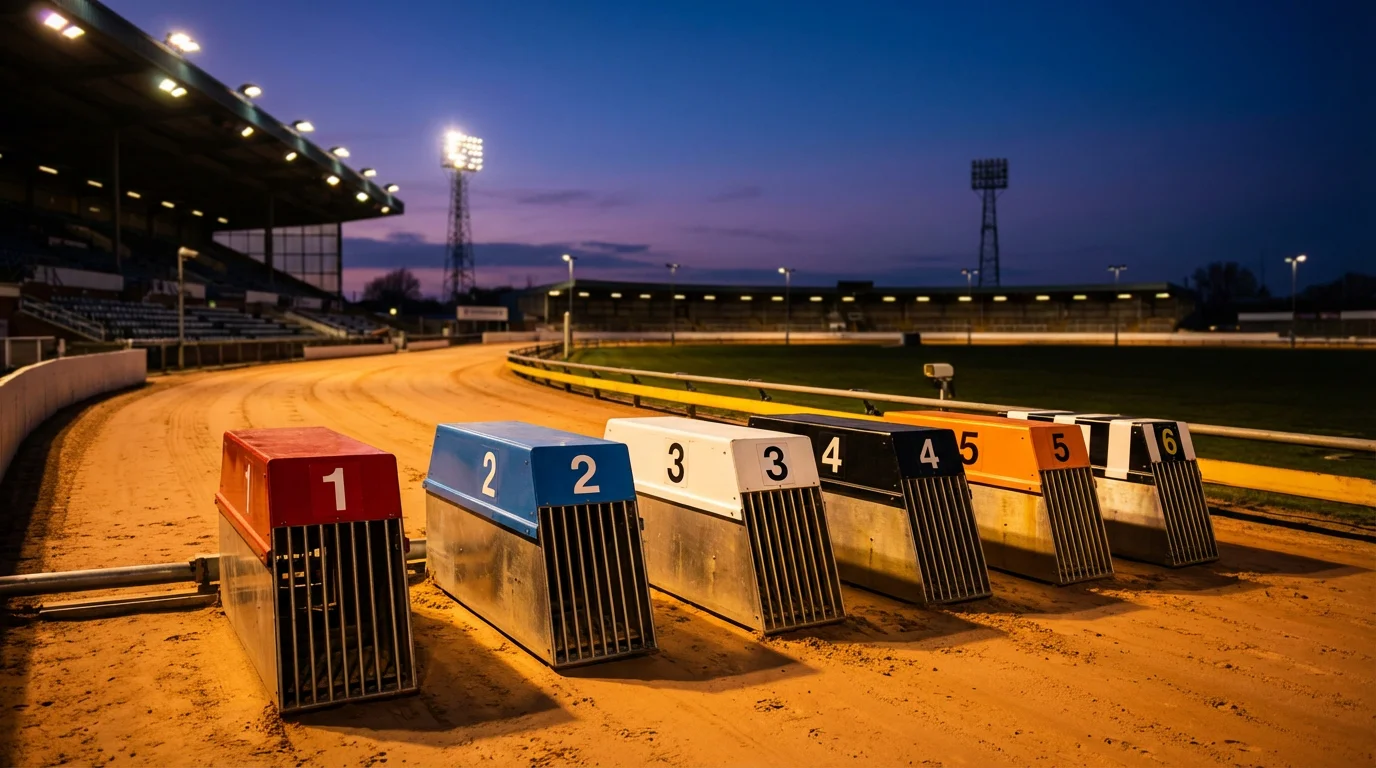
No Horse, No Jockey — Just Speed and a Rail
Greyhound racing strips competitive sport down to its mechanical core. Six dogs, a sand track, an artificial hare, and thirty seconds of flat-out running that resolves into a finishing order a bookmaker will pay out on. There is no jockey making tactical decisions mid-race, no trainer shouting instructions from the stands, no drawn-out contest of attrition across three miles of undulating turf. What you get instead is a pure test of canine athleticism filtered through a set of structural variables — trap draw, running style, track geometry, surface conditions — that are knowable, measurable, and, for the punter who takes the time to study them, exploitable.
The UK is one of a handful of countries where greyhound racing operates as a fully licensed, regulated betting sport. The Greyhound Board of Great Britain oversees the licensed circuit, the Gambling Commission regulates the betting side, and the whole operation runs to a timetable that puts racing in front of punters every day of the week, afternoon and evening, across tracks from London to the north-east. It is, by volume of fixtures, one of the most active betting sports in the country.
Yet for all that activity, greyhound betting remains poorly understood by most casual punters. The mechanics of a meeting, the structure of the betting markets, and the grading system that determines which dogs race against each other — these fundamentals are rarely explained with the care they deserve. Most guides skip straight to tips and odds. This one starts where it should: at the traps, with the hare running and the clock about to start.
Understanding how greyhound racing works is not a prerequisite for placing a bet. Any bookmaker will take your money regardless. But understanding the operational structure of the sport — how meetings are organised, how races unfold, how markets form and collapse in the space of minutes — is the prerequisite for placing bets that have a rational basis. Everything that follows in the more specialised areas of form reading, trap analysis, and odds comparison depends on this foundation.
How a Greyhound Race Meeting Is Organised
A typical race card at a UK greyhound track runs ten to fourteen races across an evening. Afternoon BAGS meetings — the fixtures broadcast into betting shops and streamed online — may be shorter, sometimes eight or nine races, but the structure is the same. Each race features six dogs, occasionally five if there is a withdrawal, racing over a set distance on the track’s sand circuit. The entire meeting, from first race to last, takes between two and three hours, with roughly fifteen minutes between races.
That fifteen-minute gap is not dead time. It is the window in which the betting market for the next race opens, moves, and effectively closes. For the on-course punter, it is when the dogs are paraded, the odds are chalked up, and the decision to bet or sit out is made. For the online bettor, it is when the race card data becomes live, the early prices appear, and the market starts to absorb information from kennel connections, form students, and professional punters whose money moves the numbers.
Race Cards, Seedings, and the Evening Programme
The race card is the central document of any meeting. Published in advance — usually one to two days before the fixture — it lists every dog entered for every race, along with the information a punter needs to make an assessment: the dog’s name, trainer, recent form figures, trap draw, best recent time, and weight. At most tracks, the card also includes comments from the racing manager summarising each dog’s running style, which feeds directly into how the traps are allocated.
Seeding is the process by which the racing manager assigns dogs to specific traps based on their preferred running line. A dog that habitually hugs the inside rail is seeded towards Trap 1 or 2. A wide runner — a dog that takes the outside line through the bends — goes to Trap 5 or 6. Middle-track runners fill the remaining positions. The aim is competitive fairness: each dog starts in the position best suited to its natural style, reducing the chance that the trap draw alone decides the result.
In practice, perfect seeding is impossible. A race with three confirmed railers means at least one will be drawn away from the inside. A card with too many wide runners forces some into middle traps. These compromises matter because a dog drawn against its preferred style faces a structural disadvantage before the traps even open. Identifying these mismatches on the race card is one of the first analytical steps an informed punter takes.
The evening programme is graded, meaning races are grouped by the standard of the dogs. Lower grades feature slower or less experienced dogs; higher grades feature faster, more proven runners. Open races, which sit above the grading structure, pit the best dogs at the track against each other regardless of grade. The programme is designed so that each race on the card offers a competitive field, which is what the betting market requires to function properly.
Kennel Presentation and Parade Ring
Before each race, the competing dogs are brought to the parade ring for inspection. On-course punters use this time to assess the dogs physically: their weight, their muscle tone, their demeanour, and their general condition. A dog that appears agitated, lethargic, or physically below its best may warrant a downgrade in your assessment, regardless of what the form figures suggest.
The parade also serves a regulatory function. The racing manager and veterinary officer inspect the dogs to confirm they are fit to race. Dogs that fail the pre-race inspection are withdrawn, which can trigger non-runner rules in the betting market and reshape the race dynamics. For the online punter who cannot see the parade, late withdrawals are flagged on betting platforms, but the physical condition information is lost — one of the few informational advantages that on-course betting still holds.
The Mechanics of a Single Race
From the moment the hare mechanism triggers to the photo finish, a greyhound race takes less than forty seconds at standard distances. That compression is part of what makes the sport distinct — and part of what makes it analytically interesting. There is no mid-race strategy, no pacing, no tactical waiting game. Everything that determines the result happens in a continuous burst of speed, and most of it happens in the first five seconds.
Trap Release, First Bend, and the Running Rail
The hare, an electrically powered lure mounted on a rail, begins its run before the traps open. It passes the starting boxes at a speed calibrated to trigger the chase instinct, and the traps spring open simultaneously. The dogs break from a standing start, accelerating to top speed within two or three strides. The distance from the traps to the first bend varies by track — at a tight venue like Romford, it can be as short as thirty metres; at a larger circuit like Towcester, it may be twice that.
This run to the first bend is the most decisive phase of the race. The dog that reaches the first turn in front, on the rail, and in clear air has an immediate structural advantage. It negotiates the bend on the shortest possible line, without interference from other runners, and exits the turn with its momentum intact. Every other dog must adjust to the positions around it, and those adjustments — checking stride, altering line, absorbing contact — cost time that is almost never recovered in a race this short.
The running rail is the inside boundary of the track, and it functions as a natural guide. Dogs that run along the rail cover the minimum distance through the bends. Wide runners cover more ground, which at racing speeds translates to measurable additional distance over a full circuit. At 480 metres, the difference between the inside rail and a line three metres wide through every bend can amount to several lengths by the finish. That geometry is constant and calculable, which is why trap draw and running style carry such weight in greyhound form analysis.
Bumping, Crowding, and Stewards’ Inquiries
Six dogs entering a bend at forty miles per hour in a space designed for clean running but routinely producing congested running — the physics guarantees contact. Bumping at the first bend is common and expected. Dogs check each other’s stride, knock each other off racing lines, and occasionally bring each other to a near-standstill. The form comment “crowded first bend” appears on race cards with a frequency that tells you everything about how often it happens.
Stewards monitor every race from the stands and via CCTV. If a dog is significantly impeded — brought almost to a halt, knocked sideways, or prevented from running its race by the actions of another dog — the stewards may call an inquiry. The outcome can range from no action, to amending the official result, to issuing a caution or sanction against the offending dog’s connections. For the bettor, the practical implication is that results can be amended after the race, and bets are settled on the official result as declared by the stewards, not the order in which the dogs crossed the line.
Interference is also a critical factor in form reading. A dog that finished fifth after being hammered at the first bend did not run to its ability, and the form figure “5” on its next race card underrepresents its chance. The race comment — the text description of each dog’s run published alongside the form figures — is where this context lives. Punters who read only the numbers miss it. Punters who read the comments find it, and the information gap between those two groups is where value quietly accumulates.
Dead Heats and Photo Finishes
Greyhound races are timed electronically, with a camera at the finish line capturing the precise moment each dog’s nose crosses the plane. When two dogs cannot be separated visually, the result is declared a dead heat, and the settlement rules are specific: winning bets on both dogs are paid at half the stake at the full odds. A £10 bet at 4/1 on a dog that dead-heats returns £25 rather than £50 — half the stake is treated as winning at the full odds, and the other half is lost.
Dead heats are more common in greyhound racing than in horse racing, partly because the margins between runners are often smaller and partly because the shorter race distance means less separation by the finish. They affect forecast and tricast bets differently from singles. A dead heat for first in a forecast market can result in the bet being voided or settled at reduced terms, depending on the bookmaker’s rules. Checking the dead heat settlement terms in your bookmaker’s rules — before you need them — avoids confusion on the night.
Photo finishes that do not result in dead heats are settled normally, with the judge’s decision final. The electronic timing system records to hundredths of a second, and at racing speeds a hundredth of a second equates to roughly a nose. The precision matters for time-based analysis but not for bet settlement: a win is a win, whether by a head or by half the straight.
How Betting Markets Open and Close at the Track
The betting market for a greyhound race is the shortest-lived in British sport. From the moment early prices appear — typically thirty to sixty minutes before the race — to the off, the entire lifecycle of the market plays out in a compressed window that rewards preparation and punishes hesitation. By comparison, a Premier League football match has its market open for days. A horse racing market might run for hours. A greyhound market is measured in minutes, and the final two minutes before the off are where the most dramatic price movements occur.
On-Course Bookmakers and Tote Boards
At the track, bookmakers operate from pitches in the betting ring, displaying odds on boards that are adjusted in real time as money comes in. The on-course market is the original greyhound betting market, and it still serves a function that online platforms cannot fully replicate: it reflects the opinions and information of people physically present at the track, including kennel connections, trainers, and regular track-goers who assess the dogs in the parade ring.
When a dog shortens sharply on-course — its price dropping from 4/1 to 2/1 in the minutes before the off — that movement often signals confidence from connections. The dog may have shown well in a trial, looked exceptionally fit in the parade, or come from a kennel whose support is a reliable indicator. These movements filter through to the off-course market, but with a delay. The punter who is physically present sees the shift first.
The Tote operates alongside the bookmakers, running pool betting where the payout is determined by the total amount staked on each dog rather than by fixed odds. Tote pools at greyhound meetings are typically smaller than at horse racing, which means individual large bets can move the pool dividends significantly. The Tote win pool is the simplest: back the winner and share the pool. The exacta and trifecta pools — the Tote equivalents of forecast and tricast bets — can produce substantial dividends when the result is unexpected.
Off-Course and Online Markets
The majority of greyhound betting in the UK now takes place off-course, either online or in betting shops. Online bookmakers publish early prices for every race on the card, and these prices adjust as bets are placed. The early price is the bookmaker’s opening assessment of each dog’s chance, and it often represents the best value available because the market has not yet absorbed the late information that drives prices down on fancied runners.
Best odds guaranteed — a promotion where the bookmaker pays out at whichever is higher, the price you took or the starting price — is widely available on greyhound racing and effectively eliminates the risk of taking an early price that drifts. If you back a dog at 5/1 and the SP is 7/1, BOG pays you at 7/1. If the SP is 3/1, you still get your 5/1. It is the single most valuable standing promotion for greyhound punters, and understanding how to use it is a foundational skill.
Betting exchanges also operate on greyhound racing, though liquidity is thinner than on horses. The exchange model — where punters bet against each other rather than against a bookmaker — allows you to both back and lay dogs, offering strategic flexibility that fixed-odds markets cannot match. Laying a dog you believe is overbet, for instance, is impossible with a traditional bookmaker but straightforward on an exchange. The lower liquidity means you may not always get matched at your desired price, but for punters who understand the exchange model, greyhounds offer a market where the competition for value is less fierce than in horse racing.
Grading, Classification, and Race Categories
The grading system is the single most important piece of structural information on a greyhound race card. It tells you, before you look at a single form figure, the approximate standard of the race and the quality range of the dogs in it. Without understanding grading, you cannot meaningfully compare a dog’s form across different races, because the context in which that form was achieved is invisible.
Graded Races: A1 Through A12
Every dog racing at a GBGB-licensed track is assigned a grade by the racing manager. The grading runs from A1 at the top to A10, A11, or even A12 at the bottom, depending on the depth of competition at the track. The letter “A” denotes standard flat racing; some tracks use “D” prefixes for specific distance categories. The number is the quality indicator: a lower number means a higher standard of competition.
Grades are determined primarily by recent race performance — finishing positions and times. A dog that wins consecutively will be promoted; a dog that finishes consistently out of the frame will be dropped. The system is fluid and reactive, with the racing manager reviewing grades after each race or short series. This creates a natural escalator effect: improving dogs rise until they reach a level where they are competitive but no longer dominant, and declining dogs fall until they find a grade they can compete in.
The critical point for punters is that grades are track-specific. An A3 at Romford is not equivalent to an A3 at Monmore or Towcester. Each track’s grading reflects the strength of its own population of racing dogs, and the standard can vary significantly between venues. A dog graded A2 at a strong track may be capable of A1 at a weaker one, and when it transfers, the initial grading at the new venue is an educated guess by the racing manager rather than a precise calibration. These transitions create betting opportunities because the market may misprice a dog whose grade at its new home does not reflect its true ability.
Promotion after a win is near-automatic. Demotion after poor results involves more judgement: a dog that finishes last after clear interference will not necessarily be dropped, while a dog that finishes last on a clear run three times running almost certainly will. The subjective element in these decisions means that some dogs sit at grades marginally above or below their true level. Finding those misplacements — a demoted dog that was unlucky, a promoted dog that was flattered — is one of the most reliable sources of value in graded racing.
Open, Invitation, and Category Races
Open races sit above the grading structure entirely. They are unrestricted by grade, meaning the best dogs at the track compete against each other in fields assembled by the racing manager based on form, quality, and competitive balance. Open races are typically the feature events on an evening card, attracting the deepest betting markets and the most scrutiny from punters and bookmakers alike.
The form analysis for open races is different from graded racing. You are no longer assessing whether a dog is well- or poorly graded relative to its opposition — every dog in the field has earned its place through performance. The focus shifts to raw ability, current form, and how the specific dynamics of the field interact: which dog leads, which sits and closes, and whether the trap draw favours the front-runners or the finishers.
Invitation races are staged for specific events or purposes and may carry eligibility criteria beyond standard grading — age restrictions, distance qualifications, or entry by invitation from the racing manager. Category races group dogs by a specific characteristic, such as maiden status or puppy age. These race types appear less frequently on the card but can offer value because their narrower eligibility pools produce fields that the market has less data to price accurately.
BAGS, SIS, and How Racing Gets to Your Screen
If you have ever bet on greyhounds in a Ladbrokes at 2pm on a Tuesday, you have watched a BAGS meeting. BAGS — the Bookmakers’ Afternoon Greyhound Service — is the commercial framework that supplies greyhound racing to betting shops and online platforms during the hours when horse racing is less active. It is the engine that keeps daily greyhound betting alive as a mass-market product, and it accounts for a substantial proportion of all greyhound races run in the UK.
BAGS meetings are scheduled to fill gaps in the betting shop content calendar. Afternoon fixtures, morning fixtures, and daytime cards at tracks across the country are timetabled to provide a continuous stream of racing from mid-morning through to early evening. The races are broadcast into shops and streamed online via SIS (Sports Information Services) and other media providers, making them available to anyone with a bookmaker account or access to a licensed betting shop.
The commercial arrangement underpinning BAGS is straightforward: bookmakers pay a fee for the right to offer betting on these fixtures, and that fee contributes to prize money and track operating costs. The system gives tracks a revenue stream beyond gate receipts and gives bookmakers a product to offer their customers between the headline horse racing fixtures. For punters, the practical effect is access to ten, fifteen, sometimes twenty or more greyhound meetings per week, each producing a full card of races with published form, available odds, and live coverage.
The quality of BAGS racing varies. Some fixtures feature solid mid-grade cards with reliable form and competitive fields. Others, particularly at smaller or less well-supported tracks, can feature weaker dogs with thinner form profiles and less predictable outcomes. The informed punter distinguishes between the two. A BAGS meeting at Monmore on a Wednesday afternoon, where the track runs constantly and the form library is deep, is a different betting proposition from a thin card at a venue with fewer regular runners. Not all BAGS meetings are created equal, and treating them as interchangeable is a mistake the market sometimes makes.
Sky Sports and other broadcast partners carry selected greyhound fixtures, particularly feature meetings and major events. The television coverage adds a layer of visibility that BAGS meetings in betting shops do not always receive, and it tends to deepen the betting market for the races shown. When a meeting is televised, more punters engage, more money flows into the market, and the odds become more competitive — all of which benefits the punter who has done their homework.
The Clock Doesn’t Wait at the Traps
The operational simplicity of greyhound racing is both its greatest commercial asset and its most persistent risk. Six dogs, thirty seconds, a result. No half-time analysis, no tactical substitutions, no weather delays that drag a fixture into tomorrow. The sport delivers outcomes at a pace that suits the modern betting market’s appetite for fast turnover, and it does so with a reliability that very few other sports can match.
But that simplicity is deceptive. Beneath the thirty-second race sits a structure — of grading, seeding, trap allocation, market formation, regulatory oversight — that determines what happens before the traps open and how you should interpret what happens after they do. The punter who sees only the race sees the least important part. The punter who understands the structure sees the race in context, and context is where every edge in greyhound betting originates.
Bet types, form reading, track-specific data, odds comparison — all of it builds on the operational foundation laid out here. None of it is complicated. All of it is worth knowing. And the starting point is what you now have: a clear picture of how the whole thing works, from the first race on the card to the last dog across the line.